
Curaçao spent the last several years rebuilding its online gambling industry around a new licensing system that was supposed to bring more transparency, direct oversight and accountability to one of the world’s biggest offshore gambling jurisdictions.
Now, leaked internal documents are giving us an unusual look at what that process actually looks like behind the scenes.
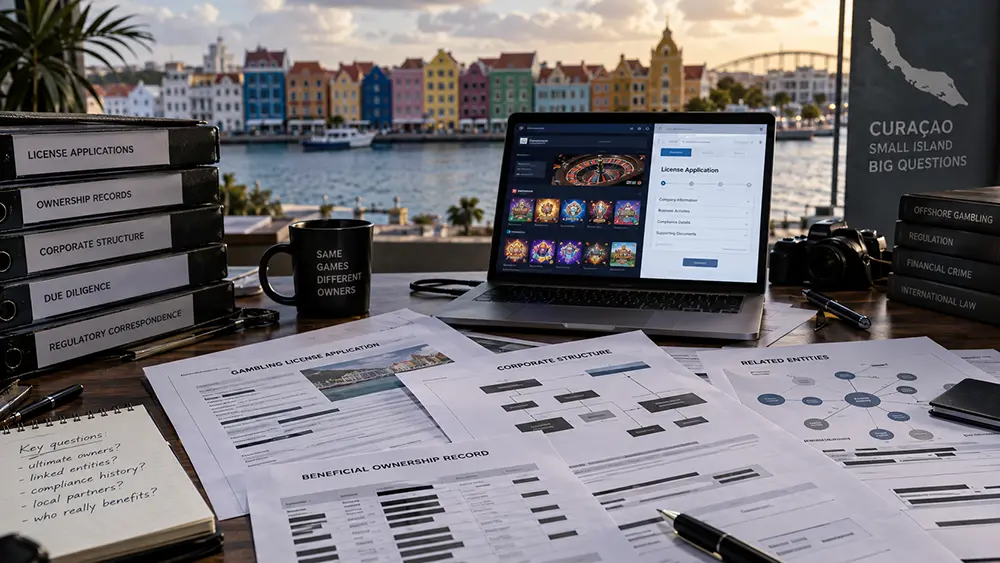
An investigation by Dutch outlet Follow the Money examined tens of thousands of documents taken from the Curaçao Gaming Authority’s licensing system. The files reportedly include license applications, regulatory assessments, ownership declarations, financial records, tax documents and other information submitted by gambling companies seeking approval.
The investigation identified around 800 owners connected to nearly 650 licensed gambling companies operating thousands of gambling websites.
But the most interesting part of the leak is not simply who owns these companies.
The documents show what Curaçao regulators were actually looking for when reviewing applications, the questions they raised about some operators and, in certain cases, why licenses were still granted while those questions remained unresolved.
For players who regularly see “Licensed in Curaçao” at the bottom of an online casino, this is a rare look at what is happening on the other side of that license.
Curaçao’s licensing system has changed significantly
For years, Curaçao operated under a licensing structure that relied heavily on master license holders.
A small number of companies held master licenses and could sublicense gambling operators underneath them. That allowed Curaçao to become one of the largest online gambling jurisdictions in the world, but it also meant the government itself was not directly licensing every casino using the jurisdiction.
That changed with Curaçao’s new gambling framework.
Under the new system, the Curaçao Gaming Authority directly licenses and supervises operators. Applicants are expected to disclose considerably more information about their businesses, including who ultimately owns the company, where its money comes from and whether it has sufficient financial resources to operate.
Those requirements are important because online casino ownership can become complicated quickly.
A casino website may be operated by one company, owned through another entity and connected to additional companies in several different countries.
The new system is supposed to give Curaçao regulators a much clearer picture of who is actually behind each operation.
The leaked documents suggest regulators are asking those questions.
They also show that getting complete answers is not always straightforward.
Regulators questioned some ownership structures
According to Follow the Money, internal assessments show Curaçao Gaming Authority staff raising questions about the ownership and corporate structures behind some applicants.
Two of the most recognizable names appearing in the investigation are Stake and 1xBet.
Stake’s Curaçao operation, Medium Rare NV, reportedly listed Serbian businessman Mladen Vuckovic as its owner in documents submitted to the regulator.
The company’s public founders, Ed Craven and Bijan Tehrani, were not listed as owners on that application.
According to the leaked assessments, regulators noticed large loans and payments involving companies and individuals connected to Craven and Tehrani and questioned whether the ownership structure presented in the application told the complete story.
That does not establish that the ownership information was false or that anyone involved committed wrongdoing.
What it does show is that Curaçao’s regulators were examining financial relationships beyond simply accepting the name written on the application.
That is exactly the kind of scrutiny the new licensing system was supposed to introduce.
1xBet raised similar questions
The documents reportedly show another complicated review involving 1xBet.
The Curaçao company associated with 1xBet, Caecus NV, listed Ukrainian national Ihor Hniedash as its owner and CEO.
However, 1xBet has long been publicly associated with Russian businessmen Roman Semiokhin, Dmitry Kazorin and Sergey Karshkov, who died in 2023.
According to the leaked documents, CGA assessors noticed the discrepancy.
Regulators reportedly suspected that the company had multiple owners and requested additional information about Hniedash’s relationship with the businessmen publicly associated with 1xBet.
The important part is what happened next.
The company ultimately received a Curaçao license even though, according to Follow the Money, regulators had not received answers to all of those questions.
At first glance, that appears to conflict with the idea of a stricter licensing system.
Curaçao’s explanation adds some important context.
Why were licenses issued with questions still open?
The Curaçao Gaming Authority has acknowledged that licenses could be granted while certain questions or uncertainties remained.
Its explanation is that the industry was going through a massive transition.
Curaçao was not building a gambling market from scratch. Hundreds of companies were already operating under the previous system and needed to be moved into a completely different regulatory framework.
Rather than immediately removing operators whenever an issue remained unresolved, the regulator says companies were being given time to satisfy the requirements of the new legislation during the transition.
That distinction matters.
There is a difference between a regulator failing to notice a questionable ownership structure and a regulator identifying the issue, requesting more information and allowing an operator additional time to resolve it.
The leaked documents appear to contain examples of the latter.
That does not mean the new system should escape scrutiny. If ownership transparency is one of the central requirements of the new framework, there is a legitimate question about how long operators should be allowed to hold licenses while important information remains outstanding.
But the files also show something that was much harder to see under the old Curaçao system.
Regulators are documenting these questions in the first place.
The leak gives us a rare look inside offshore licensing
Most players will never see any of this.
They visit an online casino, scroll to the bottom of the website and see a Curaçao license number or regulatory seal. There is very little indication of what happened before that license appeared.
The leaked documents fill in some of those gaps.
Regulators appear to be reviewing beneficial ownership, financial relationships, corporate structures and the people connected to operators. In some cases, those reviews produced additional questions that applicants were expected to answer.
That is a much more involved process than the old perception of a Curaçao license simply being something an offshore casino could easily obtain.
At the same time, the investigation shows why the strength of the new system will ultimately depend on enforcement after a license is issued.
Finding a problem is one part of regulation.
Making sure it is eventually resolved is another.
Nearly 650 companies are involved
Stake and 1xBet are useful examples because they are recognizable brands, but they are only a small part of the information contained in the leak.
Follow the Money says the documents helped identify around 800 owners connected to nearly 650 licensed gambling companies.
Those companies collectively operate thousands of gambling websites.
That scale is one of the biggest challenges facing Curaçao’s new system.
Direct licensing gives the regulator more control over operators than the old master license structure, but it also creates an enormous amount of information to review and monitor.
Every company can have owners, directors, financing arrangements, affiliated businesses and multiple domains connected to its license.
The real test for Curaçao is therefore not simply whether it can collect that information during the application process.
It is whether the regulator can continue monitoring it after hundreds of licenses have been issued.
What does a Curaçao license mean now?
The leak does not provide a simple answer.
It does, however, show that a Curaçao license in 2026 is different from the license many players became familiar with under the old system.
There is now direct government licensing. Operators are being asked to disclose ownership and financial information. Regulators are reviewing those disclosures and, based on the leaked assessments, sometimes challenging what they find.
That is meaningful progress from a system that relied heavily on private master license holders.
The unanswered question is how strict Curaçao will ultimately be when operators fail to satisfy those requests.
If companies can leave significant ownership questions unresolved indefinitely, the additional paperwork does not accomplish much.
If the CGA follows those questions through and requires operators to eventually provide satisfactory answers, the documents could instead show a regulatory system still working through the difficult transition it was designed to make.
That is why the leak matters.
Curaçao promised that its new gambling laws would bring more transparency to an offshore industry that has historically been difficult to see inside.
For the first time, we are getting a look at what that process actually looks like.
And it is considerably more complicated than a license seal at the bottom of a casino website.
Last Updated: 7 hours ago