
Key Takeaways
- A new Rutgers University study found that 42.7% of American teenagers ages 13 to 17 participated in gambling-related activities during the past year.
- Among young people who gambled, 10.3% were classified as high risk for problem gambling, with particularly concerning findings involving social casino games and prediction markets.
- Researchers identified strong connections between household gambling exposure, frequent gambling participation and gambling-related problems among young Americans.
Nearly 43% of American teenagers reported gambling during the past year, according to a new national study from Rutgers University that raises concerns about the growing accessibility of gambling and gambling-like products among young people.
The research, released October 28, 2026, by the Rutgers Center for Gambling Studies, surveyed 1,677 Americans between the ages of 13 and 27. More than half of all respondents reported participating in at least one gambling-related activity during the previous 12 months.
The findings extend beyond traditional casinos and sportsbooks. Researchers examined social casino games, prediction markets, cryptocurrency trading, raffles, bingo and other activities that can expose younger consumers to financial risk.
The results suggest that gambling-related problems are not limited to adults using licensed betting platforms. Researchers found particularly high rates of problem gambling indicators among participants in social casino games and prediction markets, two categories that do not always operate under the same regulatory framework as traditional gambling.
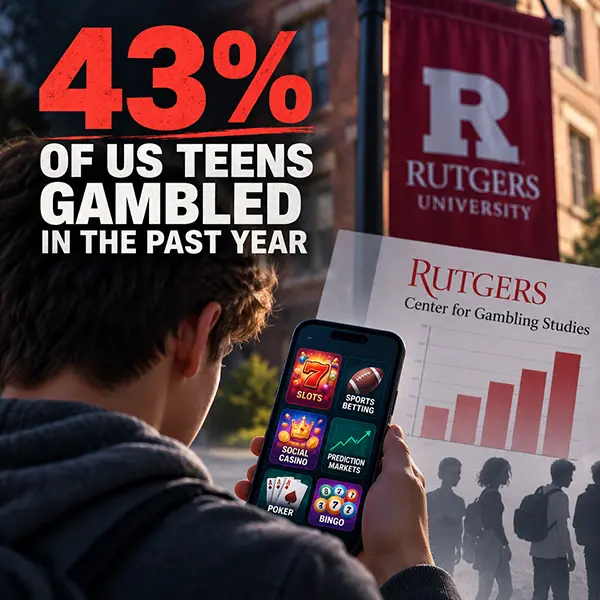
Nearly 43% of American Teenagers Reported Gambling
According to the Rutgers University study announcement, 42.7% of respondents ages 13 to 17 reported gambling during the previous year.
Among the broader group of Americans ages 13 to 27, the participation rate reached 52.5%.
The research examined 21 gambling-related activities, including both online and in-person participation. It represents one of the first major national examinations of gambling among American adolescents and emerging adults in nearly two decades.
Importantly, the 43% figure does not mean that nearly half of American teenagers are using online casinos or placing sports bets.
The study used a broad definition of gambling-related participation that included activities such as raffles, bingo and games of skill. Some of these activities carry different financial risks and legal restrictions than real-money casino gambling.
Nevertheless, the findings demonstrate how frequently young people encounter gambling or gambling-like activities.
Researchers also found that 5.4% of all survey respondents were classified as high risk for problem gambling.
Among respondents who had gambled during the previous year, 39.5% showed at least some symptoms of problem gambling, while 10.3% met the study’s high-risk screening threshold.
Approximately 11% of teenage gamblers ages 13 to 17 were classified as high risk.
These classifications are based on screening measures rather than individual clinical diagnoses, but they indicate patterns of behavior associated with potentially serious gambling-related problems.
Social Casino Players Show Particularly High Gambling Risk
One of the study’s most significant findings concerns social casino games.
Researchers found that approximately 41% of respondents who participated in social casino gaming were classified as high risk for problem gambling.
Social casinos generally offer games that resemble traditional casino products, including slot machines, blackjack and roulette, but may use virtual currencies rather than conventional cash wagers.
Some social casino platforms offer entertainment-only gameplay, while others use sweepstakes models that allow eligible players to redeem certain virtual currencies for prizes.
These differences matter because not every social casino operates as a real money gambling platform.
However, the similarities in gameplay can make the distinction less obvious to consumers, particularly younger players who may already be familiar with casino-style games through mobile applications.
The Rutgers findings raise questions about whether gambling-like entertainment products should receive greater regulatory attention, even when they fall outside conventional gambling laws.
The study does not establish that social casino games directly cause gambling addiction. People already experiencing gambling-related problems may also be more likely to participate in these products.
Still, the unusually high proportion of participants screening as high risk suggests that social casino gaming deserves closer examination.
Prediction Market Participants Also Report Elevated Risk
Prediction markets were another area of concern.
Approximately 40% of respondents who participated in prediction-market wagering were classified as high risk for problem gambling.
Prediction markets allow users to trade contracts tied to the outcomes of future events. These can include sporting events, elections, economic developments and other measurable outcomes.
Unlike conventional sportsbooks, certain prediction-market platforms operate under federal derivatives regulations rather than state sports betting laws.
That distinction has become increasingly controversial as prediction markets expand into sports-related contracts that resemble traditional betting products.
The Rutgers research suggests that the legal classification of a platform does not necessarily determine how consumers experience its financial risks.
A participant trading contracts on sporting events may face some of the same behavioral concerns as someone placing wagers through a sportsbook, even when the underlying products are regulated differently.
However, the study’s results should not be interpreted as evidence that every prediction-market platform has the same risk profile or that prediction markets are inherently more harmful than traditional gambling.
The findings identify an association between participation and high-risk gambling indicators, not a proven causal relationship.
Family Gambling Exposure Linked to Higher Risk
The study also identified a strong relationship between gambling within the household and gambling-related problems among young people.
Among teenagers classified as high risk for problem gambling, 75.5% reported having a family member who gambled.
Approximately 66.3% believed someone in their household had a gambling problem, while 61.2% reported gambling with a family member.
Across the entire survey, 41.1% of respondents reported that someone in their household gambled.
The proportion was even higher among teenagers ages 13 to 17, reaching 51.5%.
Researchers found that young people who believed a household member had a gambling problem were more than five times as likely to be classified as high risk themselves.
Those who gambled with a family member were more than four times as likely to meet the high-risk threshold.
These findings do not mean that every household where adults gamble places children at risk of developing gambling problems.
They do suggest that family attitudes, exposure and participation can play an important role in shaping gambling behavior.
For parents, the research highlights the importance of discussing gambling risks before teenagers begin encountering betting-related content through sports broadcasts, video games or social media.
Frequent Gambling and Multiple Activities Increase Risk
Another important finding involved how often young people gambled and the number of activities they participated in.
Nearly 46% of respondents who gambled reported using both online and in-person venues.
Among participants classified as high risk, that proportion increased to 65.4%.
More than half of high-risk respondents gambled at least once a week.
Researchers also found that high-risk participants engaged in an average of 6.7 gambling-related activities, compared with 2.7 among gamblers without identified problems.
This suggests that gambling risk may be associated not only with individual products but also with the frequency and variety of gambling participation.
Someone who regularly uses sportsbooks, casino-style applications, prediction markets and other gambling products may have more opportunities to experience financial losses or develop problematic gambling habits.
The research also identified associations between problem gambling and other behavioral or mental health concerns.
Among respondents classified as high risk, 52.8% reported anxiety, 38.4% reported depression and 13.1% reported suicidal thoughts.
These findings underscore the seriousness of gambling-related harm, although the survey cannot determine whether gambling contributed to those conditions or whether other underlying factors influenced both.
Lower-Income Households Report Greater Gambling Problems
Researchers also found substantial differences in gambling-related risk based on household income.
Among respondents who gambled and came from households earning less than $10,000 annually, nearly 30% were classified as high risk.
For those living in households earning between $10,000 and $20,000, the figure was 22.8%.
The results suggest that gambling-related problems may be especially concerning among young people facing financial insecurity.
Financial losses can have different consequences depending on a household’s available resources.
For someone with limited income, even relatively small gambling losses can create significant financial pressure.
However, the study does not establish that low income causes problem gambling. Other social, environmental and personal factors may contribute to the association.
Researchers Call for Stronger Gambling Protections
The Rutgers research team recommends expanding gambling prevention efforts beyond traditional casino and sportsbook regulation.
According to the study’s methodology and research summary, researchers surveyed a nationally representative, probability-based sample between April 24 and July 4, 2026, using NORC’s AmeriSpeak panel.
The results were weighted to national population benchmarks, with a maximum margin of error of approximately 3.2 percentage points overall and 6.1 percentage points for teenagers.
Researchers recommended beginning gambling prevention education in middle school, including programs designed for students, parents, teachers and counselors.
They also called for stronger oversight of social casino games, prediction markets and other products that may fall outside traditional gambling safeguards.
Another recommendation involves establishing national minimum consumer protection standards, including broader self-exclusion systems that would apply across multiple gambling platforms.
Currently, gambling regulations and responsible gambling requirements vary considerably across the United States.
Licensed online casinos operate under state-specific requirements, while offshore gambling platforms and certain emerging products may be subject to different forms of oversight.
The researchers argue that consumer protections should account for how people actually participate in gambling rather than focusing exclusively on the legal classification of individual products.
What the Findings Mean for Online Casino Regulation
The Rutgers study arrives as US regulators continue debating how to oversee online gambling, sweepstakes casinos and prediction markets.
Licensed real money online casinos generally operate under state gambling regulations that include age verification, identity checks and responsible gambling requirements.
Those protections are intended to prevent underage participation and provide safeguards for customers experiencing gambling-related problems.
However, the broader gambling environment now includes products that may not fit neatly within existing regulatory categories.
Social casino applications, promotional sweepstakes games and prediction markets can expose users to gambling-like experiences without necessarily being subject to identical licensing standards.
The Rutgers findings suggest that regulators may need to examine these products alongside conventional gambling platforms.
For consumers, understanding the difference between regulated online casinos, offshore operators and social gaming products remains important.
Anyone comparing gambling platforms should consider licensing, age restrictions, consumer protections and the availability of tools designed to help users control their gambling.
OnlineCasinos247 provides additional information about these issues in its Responsible Gambling guide.
What Happens Next?
The Rutgers study provides a new national benchmark for understanding gambling participation among American teenagers and young adults.
Its most significant finding is not simply that 43% of teenagers reported gambling-related activity during the previous year.
It is that a meaningful share of young participants showed signs of gambling-related problems, particularly those involved in multiple activities, exposed to gambling at home or participating in emerging gambling products.
The findings also highlight the difficulty of addressing gambling risks through regulations focused only on traditional casinos and sportsbooks.
As online gambling, prediction markets and casino-style gaming applications continue evolving, researchers are calling for broader prevention efforts and more consistent consumer protections.
For parents, educators and policymakers, the central question is how to identify and address gambling-related risks before young people develop lasting problems.
Last Updated: 13 minutes ago


