
New York’s fight with prediction markets has reached Polymarket, and neither side is backing down.
New York Attorney General Letitia James filed a lawsuit against Polymarket on September 24, accusing the company of operating an illegal and unlicensed gambling platform in the state.
Polymarket responded hours later with a lawsuit of its own.
The company is asking a federal court to stop New York officials from regulating its prediction markets, arguing that Polymarket operates as a federally regulated derivatives exchange under the Commodity Futures Trading Commission and that states do not have the authority to apply their gambling laws to its event contracts.
That leaves New York and Polymarket fighting over a question that is becoming increasingly important for the entire US gambling industry.
When someone puts money on whether a football team will win a game, is that sports betting because of what the customer is doing?
Or is it a federally regulated financial contract because of how the market is structured?
New York says the first answer is obvious.
Polymarket says federal law says otherwise.
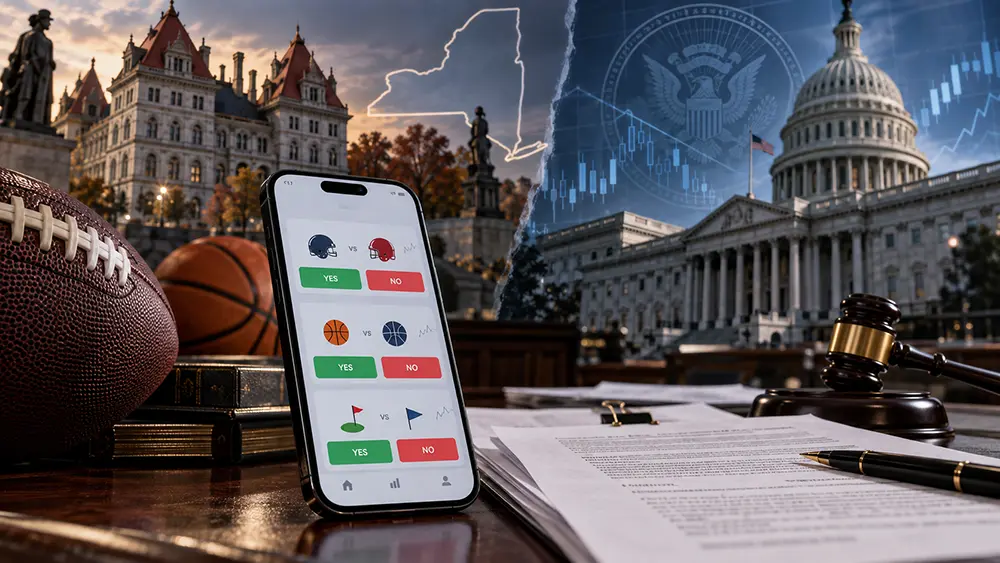
New York says Polymarket is offering gambling without a license
Polymarket allows customers to buy contracts based on whether an event will happen.
A market might ask whether a team will win a game, whether a political candidate will win an election or whether something will happen in entertainment or popular culture.
Customers can generally buy Yes or No contracts, with prices moving as traders buy and sell positions.
Polymarket considers those products event contracts.
New York considers many of them bets.
The state’s lawsuit argues that Polymarket is allowing New Yorkers to risk money on uncertain events outside of their control without holding a New York gambling license.
The Attorney General’s office even conducted its own test.
According to the state’s filing, an investigator using a New York based account spent $3.01, including fees, to purchase 6.39 contracts predicting that the New York Mets would defeat the Atlanta Braves in a July baseball game.
The Mets won.
The account received $6.39.
From New York’s perspective, the transaction looked a lot like a sports bet regardless of whether the product was called an event contract.
New York is also challenging markets that licensed sportsbooks cannot offer
The state’s argument goes beyond Polymarket simply competing with DraftKings, FanDuel and other licensed sportsbooks.
New York says Polymarket has offered markets that regulated sportsbooks in the state would not be permitted to offer.
That includes contracts involving New York college teams.
New York generally prohibits licensed sportsbooks from accepting wagers on games involving colleges located within the state. The Attorney General’s filing points to Polymarket markets involving teams including Syracuse, St. John’s, the University at Buffalo and the University at Albany.
There is also an age difference.
New York requires customers to be at least 21 to use licensed mobile sportsbooks.
Polymarket allows customers beginning at age 18.
That creates an unusual situation where an 18 year old could potentially trade a contract on the outcome of a sporting event through a federally regulated prediction market while being too young to place what looks like a very similar wager through a New York licensed sportsbook.
For state regulators, those differences are becoming increasingly difficult to ignore.
New York is asking for potentially significant penalties
New York is not simply asking Polymarket to change a few markets.
The state wants a court order preventing the company from operating what it considers an unlicensed gambling business in New York.
It is also seeking restitution for users, forfeiture of gains connected to the alleged violations and civil penalties.
One of the more significant requests involves sports markets.
New York is seeking $100,000 for each alleged unauthorized offer or attempted offer of sports wagering or mobile sports wagering in the state.
That does not mean Polymarket currently owes New York $100,000 for every sports market it has offered. These are penalties the state is asking a court to impose, and the underlying case has not been decided.
But it shows how serious the financial consequences could become if New York ultimately succeeds.
Polymarket has chosen to fight rather than leave.
Polymarket says New York does not have jurisdiction
Hours after New York filed its case, Polymarket filed a separate lawsuit in Manhattan federal court against Attorney General James and officials from the New York State Gaming Commission.
Its argument goes directly to the heart of the prediction market debate.
Polymarket says its event contracts are federally regulated derivatives and fall under the jurisdiction of the Commodity Futures Trading Commission.
The company therefore argues that New York cannot simply decide those same products are sports bets and regulate them under state gambling law.
That distinction is the foundation of the prediction market business model in the United States.
Traditional sportsbooks operate state by state.
A company such as DraftKings or FanDuel needs approval in each jurisdiction where it wants to offer sports betting. It must follow state specific rules covering everything from taxes and approved betting markets to minimum age requirements and responsible gambling protections.
Prediction markets operate under a very different structure.
Their argument is that event contracts traded on federally regulated exchanges belong under federal commodities law rather than individual state gambling laws.
If that argument holds, prediction markets could continue offering sports related contracts without becoming sportsbooks in every state where customers use them.
If states successfully challenge that position, the business could look very different.
This fight is much bigger than Polymarket
New York’s case against Polymarket is not happening in isolation.
The state has already taken similar action against Kalshi and has also challenged prediction market products connected to Coinbase and Gemini.
Other states are fighting their own battles.
Nevada has argued that sports event contracts can fall under state gaming regulation. California tribes have challenged prediction markets under federal Indian gaming law. Connecticut has also moved against multiple prediction market platforms.
The result is a regulatory fight developing across several different courts and jurisdictions at the same time.
The companies continue to make essentially the same argument: federally regulated event contracts are not the same product as state regulated sports betting.
States increasingly disagree.
What makes the Polymarket case particularly important is the company’s size and growth.
Polymarket has moved well beyond the niche crypto prediction platform that became widely known during the 2024 presidential election. Its markets now cover sports, politics, economics, entertainment and other events, while the company has expanded its presence in the regulated US market.
That growth makes the question of who actually regulates these products much harder to avoid.
The line between prediction markets and sportsbooks is getting thinner
For players, the legal distinction can sometimes feel disconnected from what is actually happening on the screen.
A sportsbook might offer a moneyline on whether the Buffalo Bills win on Sunday.
A prediction market might offer a contract asking whether the Buffalo Bills will win on Sunday.
The interfaces, pricing and mechanics can be different, but in both cases the customer can put money behind a prediction about the outcome of the same football game.
The regulatory treatment can be completely different.
That is why this fight matters to the wider gambling industry.
Licensed sportsbooks have spent years entering individual states, paying gaming taxes and complying with local rules. Prediction markets are building competing sports products under a federal framework that they argue allows them to operate without going through that same state licensing process.
For states such as New York, that threatens more than the existing regulatory structure. It could also affect tax revenue and the state’s ability to decide which betting markets are allowed.
For prediction markets, allowing every state to classify event contracts as gambling could undermine the entire advantage of operating through a federally regulated exchange.
Neither side has much incentive to compromise.
Courts may ultimately decide what prediction markets become
Prediction markets are no longer a small corner of the gambling and financial markets.
Polymarket and Kalshi are attracting substantial trading volume, expanding their sports offerings and increasingly competing for the same customers who might otherwise use traditional sportsbooks.
The regulatory system has not caught up nearly as quickly.
New York’s lawsuit brings that conflict into one of the largest legal sports betting markets in the country.
Polymarket’s immediate decision to sue back makes the stakes even clearer.
New York wants prediction markets offering sports contracts to follow the same basic gambling rules as other companies taking sports wagers in the state.
Polymarket believes New York does not have the authority to make that demand.
One of them is eventually going to have to give.
And with similar cases developing around the country, the answer could determine whether prediction markets remain a separate federally regulated industry or move much closer to the state by state system that already governs US sports betting.
Last Updated: 1 day ago