
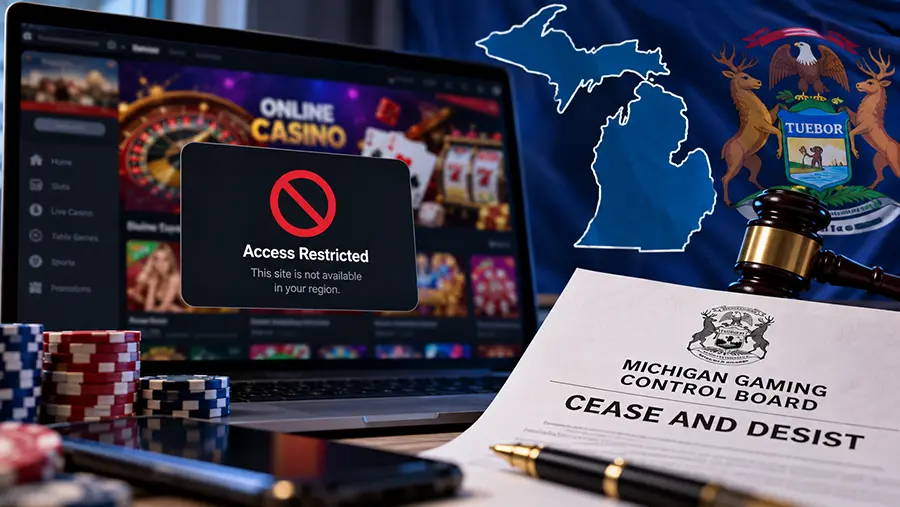
Michigan has issued another round of cease and desist letters to offshore gambling operators, targeting 33 websites and businesses accused of offering online casino games, sweepstakes style gaming and sports betting to residents without state authorization.
The Michigan Gaming Control Board announced the enforcement action on October 8, naming several established offshore casino brands, including Raging Bull Slots, Sloto’Cash, mBit Casino, iWild Casino and Regal Casino and Sportsbook. State investigators determined that the targeted operators were offering gambling products to Michigan residents without the licenses required under state law.
The announcement is the latest in a growing enforcement campaign against offshore gambling. Michigan previously announced action against 45 operators in April, and regulators have continued targeting additional websites throughout the year. However, the latest action raises a familiar question about offshore gambling enforcement: how much can a state regulator accomplish when the businesses it is targeting operate outside its jurisdiction?
Several Established Offshore Casinos Are Among the 33 Operators
The latest enforcement action covers a mixture of traditional online casinos, cryptocurrency gambling platforms, sportsbooks and sweepstakes style gaming websites. Some are relatively unfamiliar brands, while others have operated in the international online gambling market for years.
Among the better known names are Raging Bull Slots, Sloto’Cash, mBit Casino, iWild Casino and Regal Casino and Sportsbook. The regulator also identified Ronin Slots, Slot Paradise, Spin Dinero, Sloto Tribe, Stardust, SunnySpins Casino and The Online Casino, along with numerous other operators.
Michigan says its investigations established that the targeted businesses were offering casino games, sports wagering or sweepstakes style products to people located in the state. The regulator has instructed the operators to stop those activities, warning that companies ignoring the directives could face additional enforcement involving the Michigan Department of Attorney General.
It is important to distinguish between receiving a cease and desist letter and actually leaving the market. The October 8 announcement does not establish that all 33 operators have blocked Michigan residents, closed existing accounts or stopped accepting deposits. Those outcomes would need to be confirmed separately.
Michigan Has Already Targeted Dozens of Offshore Gambling Operators
The latest action is part of a broader campaign that has been underway for some time. In April 2026, the Michigan Gaming Control Board announced that it had issued cease and desist orders to 45 offshore operators over the preceding four months.
That earlier list included BetOnline.ag, SportsBetting.ag, Americas Cardroom and several other established gambling brands. Michigan has also previously targeted Everygame, Super Slots and a range of smaller offshore casinos.
The repeated announcements show that Michigan is not limiting enforcement to newly launched websites or operators with little history in the industry. Its approach extends to international gambling businesses that have served American customers for years, including companies that may hold licenses in jurisdictions outside the United States.
An offshore license, however, does not provide permission to operate in Michigan. The state’s Lawful Internet Gaming Act and Lawful Sports Betting Act require operators to obtain Michigan authorization before offering covered gambling products to residents. A company can hold a license in another jurisdiction and still be operating without the authorization Michigan requires.
That distinction is central to the state’s position. Michigan is not necessarily questioning whether every named operator holds a foreign gambling license. It is saying those licenses do not replace the state’s own licensing requirements.
Regulators Are Focusing on Players Who Have Self Excluded
One of the more notable parts of the October 8 announcement is Michigan’s emphasis on responsible gambling protections, particularly for people who have voluntarily excluded themselves from online gambling.
Michigan maintains an Internet Gaming and Sports Betting Responsible Gaming Database that allows eligible individuals to exclude themselves from the state’s regulated online gambling market. Licensed operators must honor those exclusions, preventing enrolled individuals from accessing covered gambling services.
Offshore operators are not required to participate in Michigan’s database. That means a person who has voluntarily excluded themselves from licensed gambling websites may still be able to register and deposit money at an offshore casino.
The regulator argues that this creates a significant gap in consumer protection. Someone attempting to stop gambling could find that restrictions applying to licensed Michigan operators do not extend to websites operating outside the state’s system.
The distinction does not mean every offshore casino lacks responsible gambling tools. Some international operators offer account limits, cooling off periods and voluntary exclusion programs under their own policies or licensing requirements. The issue is that those programs are not necessarily connected to Michigan’s statewide system, and the state regulator cannot require the same compliance from an operator it does not license.
Michigan also points to differences in game testing, financial safeguards and dispute resolution. Players using websites outside its regulatory system generally cannot turn to the Michigan Gaming Control Board to resolve a withheld withdrawal or account dispute in the same way they can with a state licensed operator.
Can Michigan Actually Stop Offshore Casinos From Accepting Players?
This is where the latest announcement becomes more complicated. Michigan has authority to regulate gambling offered within its borders, but many offshore casino businesses are incorporated and operated in other countries.
A cease and desist letter formally notifies an operator of the state’s position and demands that it stop offering gambling to Michigan residents. It can also establish a basis for further enforcement if the operator continues serving the market.
What the letter does not automatically do is shut down a foreign website or prevent Michigan residents from accessing it. An operator may voluntarily introduce geographic restrictions, stop accepting registrations from the state or close existing accounts. Others may dispute the regulator’s position or continue operating until additional pressure is applied.
The practical results depend on how individual companies respond and what additional measures regulators can pursue. Payment relationships, business partners and other connections to the United States may create enforcement opportunities, but the October announcement does not identify new restrictions involving payment processors or internet service providers.
That makes compliance the important next development. Michigan has issued a substantial number of letters over the past year, but the total number of enforcement notices does not, by itself, show how many offshore casinos have actually stopped serving residents.
Offshore Gambling Remains a Significant Part of the US Market
Michigan’s enforcement campaign also reflects a larger challenge facing regulated online gambling in the United States. State licensing has expanded considerably, but offshore gambling websites continue to attract American customers.
The American Gaming Association estimated in an August 2025 report that Americans wager approximately $673.6 billion annually through illegal and unregulated gambling channels, a category that includes offshore websites and other unauthorized gambling activity.
The same research estimated that the share of online casino players using only legal operators had fallen from 52% in 2022 to 24%. Those estimates come from industry commissioned research and should not be treated as precise measurements of every gambling transaction, but they illustrate why state regulators remain concerned about competition from outside their licensing systems.
The offshore market is not a single category of identical operators. It includes established international gambling brands, cryptocurrency casinos, sportsbooks, newer gaming websites and businesses with different licensing arrangements and operating histories.
For regulators, however, the central issue is authorization within the state. Whether an offshore casino has operated for two years or twenty, Michigan requires its own license before the operator can legally offer covered gambling services to residents.
What the Latest Enforcement Action Means for Players
For Michigan residents who currently use one of the named offshore casinos, the announcement creates uncertainty about whether those websites will continue accepting customers from the state.
Some operators may respond by restricting access, while others may make changes to registration, deposits or withdrawals. Players with existing balances should pay particular attention to any account notices or changes in withdrawal policies, although the regulator has not announced that all 33 sites are closing accounts or freezing player funds.
The enforcement action also does not automatically determine what happens to money already held in offshore casino accounts. Those questions may depend on the individual operator’s terms, applicable law and how the company responds to Michigan’s directive.
For the broader offshore gambling industry, the significance is less about any single casino on the list and more about the direction of state enforcement. Michigan has made it clear that established international brands are not exempt from its licensing requirements, and it is continuing to identify operators it believes are serving residents without authorization.
The remaining question is whether the campaign produces measurable changes in the market. Sending letters is one part of enforcement, but the more meaningful results will be whether operators restrict Michigan customers, whether further legal action follows and whether the state can demonstrate that fewer residents are accessing unauthorized gambling websites.
Michigan’s latest action adds 33 more targets to that effort. What happens after the letters arrive will ultimately say more about the effectiveness of the state’s offshore gambling crackdown than the number of operators named in the announcement.
Last Updated: 1 hour ago