
How Online Casinos Make Money
Online casinos make money the same way the one on the Strip does. Every game pays out a little less than true odds, and over enough bets that gap turns into the casino’s income. There is no secret to it, no switch that gets flipped when you start winning, and no need for one. The arithmetic does the work.
This page walks through that arithmetic with real numbers, then covers the parts people ask about less: bonuses, what the casino pays out in costs, and why some of them still go broke.
The house edge is the whole business
Take European roulette. There are 37 pockets. A bet on a single number pays 35 to 1. If the payout matched the odds it would pay 36 to 1. That one missing unit is the edge: 1 divided by 37, or 2.7 percent of every dollar bet on that wheel, kept by the house over time.
Every game has a number like that.
- Blackjack, played well: around 0.5 percent
- Baccarat, banker bet: 1.06 percent
- Craps, pass line: 1.41 percent
- European roulette: 2.7 percent
- American roulette (two zeros): 5.26 percent
- Slots: anywhere from 2 to 10 percent, set per game by the provider
For slots the number is usually quoted the other way round, as RTP, return to player. A slot with 96 percent RTP has a 4 percent edge. A slot with 92 percent RTP has an 8 percent edge, and it will cost you twice as much to play over a year even though it feels the same.
The edge is not what you lose on one session. On any given night you can win, and plenty of people do. It is what the casino keeps on average across every bet from every player. One player’s good night is paid for by the thousand other sessions that went the other way.
What that edge is worth per player
The figure that matters to the casino is not your deposit. It is your handle, the total amount you wager, which is far bigger than your deposit because you bet the same money over and over.
Say you deposit $100 and play a 96 percent slot at $1 a spin. You do not lose $4 and stop. You spin, win some back, spin again. By the time the $100 is gone you have put something like $2,500 through the machine. Four percent of $2,500 is $100. That is where your deposit went.
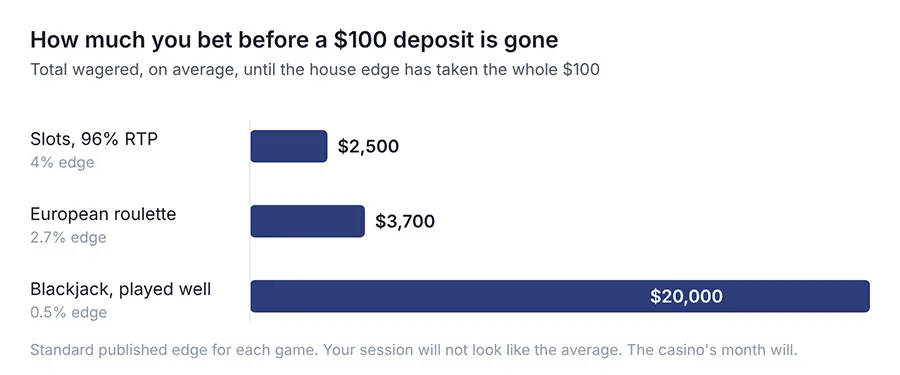
Flip it round and you get the number casinos actually plan around. A player who deposits $100 a month and plays slots is worth about $100 a month to the casino, give or take, because almost everyone eventually plays their deposit down to zero. A blackjack player who plays well and bets the same amount is worth $12 a month on the same handle. That is why the lobby pushes slots and buries the blackjack tables, and why slot players get the bigger bonuses.
Why nobody needs to rig anything
Every few months someone emails us certain a casino cheated them because they lost six times in a row. Six losses in a row at 48 percent happens about one time in fifty. It will happen to you, more than once, in a normal year of playing.
The honest reason a casino does not rig the games is that it does not have to. A 4 percent edge on a slot that gets spun ten million times a month is $400,000 in revenue from that one game, and the players who lost it will mostly come back, because they had fun and some of them won. Rigging that game to take 8 percent would roughly double the revenue for a month and then the game would feel wrong, players would leave, and the provider who made the game would pull the licence. The math already works; breaking it is bad business.
Where casinos do take more than the published edge is not in the games. It is in the terms. A bonus you cannot cash out, a withdrawal that stalls until you give up and play the balance back, a maximum bet rule you did not know about. We cover those on the withdrawals guide and the bonus guide, and the casinos that do it as a habit are on the rogue list.
Bonuses are not generosity
A 100 percent match bonus up to $1,000 looks like the casino giving money away. It is the opposite. The casino is buying handle.
Say you deposit $200 and take the $200 match. The terms say 35x wagering on bonus plus deposit, which is normal. That means $14,000 in bets before you can withdraw. At a 4 percent edge, $14,000 of handle is worth $560 to the casino. They gave you $200 to get it. Most players never reach the end of the wagering; the balance runs out first, and the casino keeps the deposit, the bonus and whatever was won along the way.
The bonus is a loan with an interest rate of roughly 180 percent, paid in spins. It is a good deal for the casino nearly every time, which is why every casino offers one. It is only a good deal for you if you would have made those bets anyway.
Where the money goes
Gross gaming revenue is the industry term for what the edge collects: total bets minus total payouts. Out of that, a typical offshore casino pays:
- Game providers. RTG, Betsoft, Rival and the rest charge a share of the revenue their games produce, often 10 to 15 percent.
- Payment processing. Cards are expensive for offshore operators, 5 to 10 percent and sometimes more, which is why they push crypto so hard: a Bitcoin deposit costs them almost nothing.
- Marketing and advertising. Sites like this one are paid a referral fee per depositor, plus whatever advertising the casino can buy, which for an offshore operator means sponsorships, streamers and placements on sites like ours rather than Google or TV. It is usually the biggest cost after the games themselves.
- Bonuses as above, which are a cost of acquiring and keeping players.
- Licence, staff, support, fraud. Smaller than you’d think at the offshore end; a Curacao licence is cheap and support is outsourced.
What is left is the margin, and at a well-run casino it is large. That is the part people have right: it is a very profitable business.
Why some of them still go broke
If the edge is guaranteed, how does a casino close owing players money? Three ways we’ve watched happen since 2011.
They spend the float. Player balances are not the casino’s money; they are deposits waiting to be withdrawn. A casino that uses them for marketing or pays its owners out of them is fine until a few big winners cash out in the same week.
A processor pulls out. Offshore casinos live or die on getting money in and out. When a card processor drops them, deposits stop, revenue stops, and the ones with no reserve stop paying within a month.
They were never a casino. Some were set up to collect deposits and vanish. The games were real, the licence was real enough, the cashier was never going to pay. The pattern shows up in the first few months as slow pay and verification requests that never end.
The casinos that survive twenty years are the boring ones: they keep player money separate, they have three processors instead of one, and they pay on time because paying on time is cheaper than losing players. Those are the ones we send people to.
The short version
The casino keeps a few percent of everything you bet. Over enough bets, that is all it needs. Games are not rigged, because rigging them would cost more than it earns. Bonuses are the casino buying your bets at a discount. The money you lose goes to game makers, payment processors, marketing and the owners, in that order. And the ones that close owing money did not lose the edge; they lost the discipline.