
Adidas has introduced TRIONDA as the official match ball for the 2026 FIFA World Cup, and the biggest story is not the color scheme, the design, or even the fact that it represents three host countries. The real story is that the ball is now part football and part smart device.
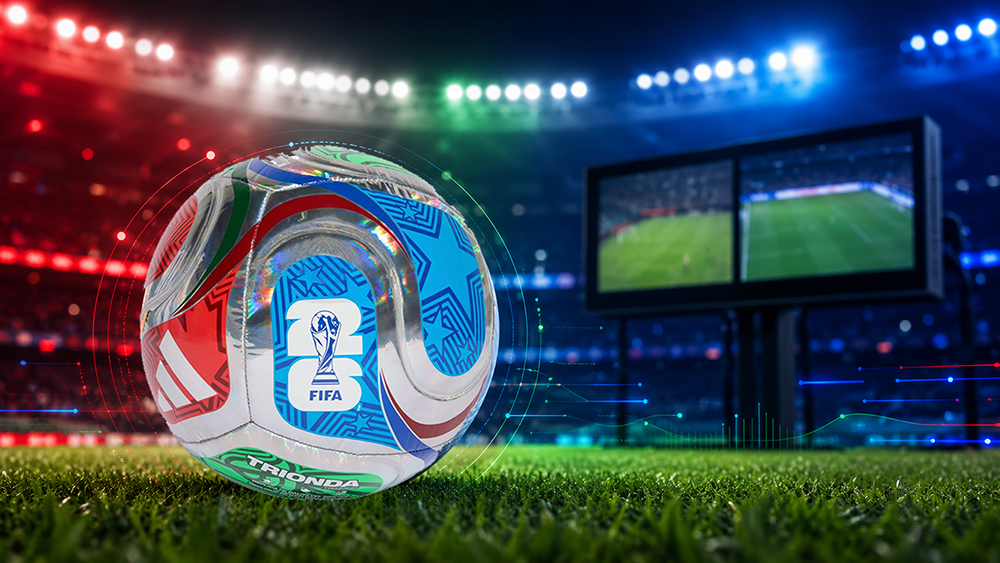
The Tech inside the TRIONDA ball
TRIONDA includes connected ball technology designed to track movement, detect touches, and send match data in real time. A sensor inside the ball helps officials identify events that cameras alone can miss, including close touches, deflections, and the exact moment the ball is played.
That matters because World Cup matches are increasingly being decided by very small margins. A toe, a shoulder, a deflection, or a delayed offside review can change the entire direction of a match. The new ball is meant to give officials another layer of data instead of relying only on camera angles and human interpretation.
For fans, the easiest way to understand it is simple. The ball can help tell officials when it was touched and how it moved. That information can then be used with semi-automated offside technology and VAR systems to make decisions faster and with more precision.
That also means the ball has to be charged before kickoff. This is no longer just leather, air, stitching, and branding. The match ball is actively collecting and transmitting data throughout the game, so the technology inside it needs power.
This is where soccer is clearly heading. The 2026 World Cup will already be the largest version of the tournament ever, with 48 teams and matches across the United States, Canada, and Mexico. Now the ball itself is part of the technology system surrounding the tournament.
Adidas designed TRIONDA around the three host nations. The name plays off the idea of three waves coming together, and the red, green, and blue design is meant to represent Canada, Mexico, and the United States. That part is the traditional World Cup ball story. Every tournament has a ball with a look, a name, and a design theme.
The bigger shift is what happens inside the game.
Connected ball technology gives referees and VAR officials another tool for moments that are hard to judge live. Offside is the obvious example. In modern soccer, the key question is often not only where the attacker was standing, but when the ball was played. If the ball can help identify that moment more accurately, the offside decision becomes cleaner.
The same idea applies to handball reviews, possible deflections, and tight goal-area moments where the ball changes direction quickly. Cameras are still important, but the ball data can help explain what happened when the video is unclear.
For bettors, this is worth paying attention to because officiating technology can affect how games flow. Faster offside decisions could reduce long VAR delays. More accurate touch detection could change some goal reviews, assists, deflections, and scoring sequences. None of that means the ball gives bettors some secret edge, but it does mean the World Cup betting environment is becoming more data-driven.
Live betting is the area where this matters most. Modern soccer markets already move quickly after goals, cards, substitutions, injuries, and VAR checks. If technology shortens some reviews or gives officials more confidence on close decisions, it can affect how long markets stay suspended and how quickly odds reopen.
The important thing is not to overstate it. TRIONDA is built to support match officials. It is not a public betting tool, and sportsbooks are not suddenly giving casual bettors access to the same internal data feed. The value for bettors is understanding how the game is being officiated and how technology may influence key moments.
There is also a trust angle. VAR has been one of the most controversial parts of modern soccer because fans often feel like they are waiting for a decision without knowing exactly what is being reviewed. Semi-automated systems and connected ball data are meant to make those calls faster and more transparent, even if not every fan will love the result.
The 2026 World Cup is going to be a test case for the next version of soccer. Bigger tournament. More matches. More betting markets. More technology. More data. More decisions supported by systems that most fans never see directly.
The ball is now part of that shift.
TRIONDA may still look like a World Cup ball sitting on the center spot before kickoff, but once the match starts, it becomes part of the officiating system. It tracks, measures, and communicates in the background while the players do what they have always done.
That is the real story. The most important technology at the 2026 World Cup may not be in the stadium roof, the broadcast truck, or the VAR room.
It may be inside the ball.
Last Updated: 3 months ago