
College football is back, and for bettors that means one of the busiest sports betting markets in the United States is open again.
The 2026 season brings hundreds of games every week, point spreads that can reach three or four touchdowns, constantly changing rosters, and a 12 team College Football Playoff waiting at the end of the schedule.
It also creates a very different betting environment from the NFL.
An NFL bettor can usually assume both teams have professional level depth and relatively complete injury information. College football is not that simple. The difference between the best and worst players on a roster can be enormous. A starting quarterback can completely change a point spread, and information about injuries or lineup changes is not always released as consistently as it is in professional sports.
That does not make college football impossible to bet.
It means understanding the market matters just as much as knowing the teams.
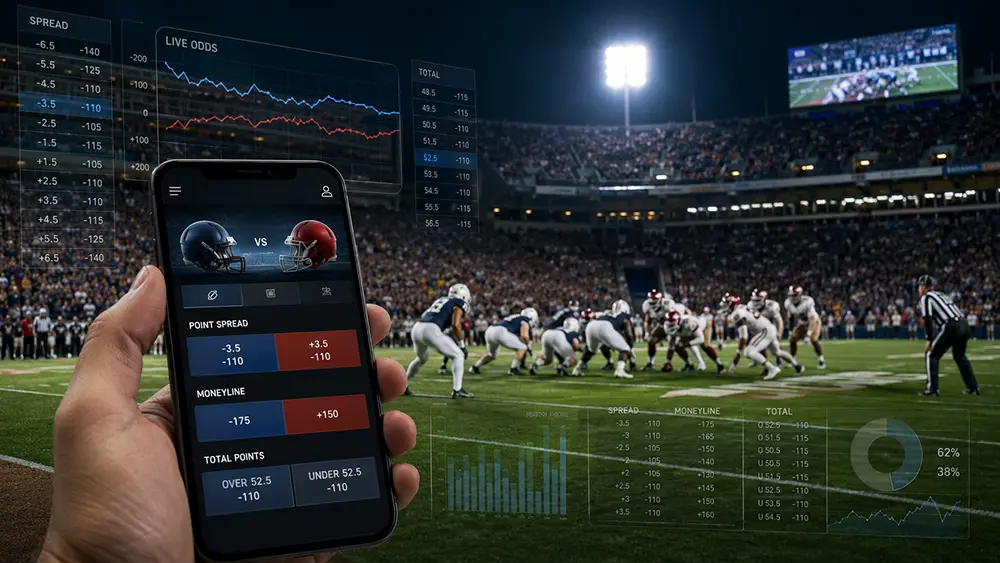
College Football Betting Is Different From the NFL
The biggest mistake new college football bettors make is treating every game like an NFL matchup.
College football has much larger talent gaps.
Ohio State playing another top ten program is completely different from Ohio State playing an overmatched nonconference opponent. That difference shows up in spreads of 30, 40, or sometimes even 50 points.
Those numbers can look ridiculous to someone used to NFL betting, but they are not automatically bad lines.
A 35 point favorite does not need a competitive game to cover. It needs the stronger team to keep scoring long enough before backups enter and the game slows down.
That creates another college specific problem.
Garbage time matters.
A favorite can dominate for three quarters, lead by 38 points, replace most of its starters, and allow two late touchdowns that turn an easy cover into a losing bet.
The final score does not always tell you what happened.
That is why college football bettors should pay attention to depth, coaching tendencies, and how aggressively a team normally plays with a large lead.
Point Spreads Are the Main College Football Market
The point spread remains the most important betting market in college football.
A favorite listed at minus 7.5 needs to win by eight or more points for the bet to cash. The underdog can lose by seven and still cover.
The basic concept is simple.
Finding the right number is harder.
College football spreads can move significantly during the week because one piece of information can change how the market evaluates an entire offense or defense.
Quarterbacks matter most.
A starting quarterback being ruled out can move a line several points, particularly when the backup has little experience. Offensive line injuries, defensive suspensions, weather, and roster availability can also move the number.
This makes timing important.
If you believe a team is undervalued at minus 6.5, waiting until Saturday morning may mean betting minus 7.5 instead. That one point can decide whether the bet wins, loses, or pushes.
It is also why line shopping matters.
One sportsbook may have Georgia minus 7 while another has minus 7.5. Those numbers look almost identical until Georgia wins by exactly seven.
Getting the better number should always matter more than loyalty to one sportsbook.
Do Not Be Afraid of Large Spreads
College football regularly produces spreads that would almost never appear in the NFL.
That can make bettors automatically prefer the underdog.
A team getting 38 points looks attractive because it feels like an enormous head start.
Sometimes it is.
Sometimes the favorite is still cheap.
The important question is not whether the spread looks large. It is whether the difference between the teams is larger than the number.
A championship contender playing a lower level opponent may have significant advantages at quarterback, offensive line, defensive line, speed, coaching, and depth.
If the favorite can score almost every possession while the underdog struggles to cross midfield, 35 points can disappear quickly.
The opposite problem also exists.
A team may be capable of winning by 40 but have no reason to do it.
If a major conference favorite has another important game the following week, the coaching staff may pull starters early once the result is secure.
That is where matchup analysis becomes more useful than simply looking at rankings.
College Football Totals Can Be More Volatile
Totals can be especially interesting in college football because offensive styles vary much more than they do in the NFL.
Some teams want to run 80 plays and move as quickly as possible.
Others are comfortable shortening the game, running the football, and using as much clock as possible.
Two games with similar talent levels can therefore produce completely different betting environments.
When looking at an over or under, scoring averages only tell part of the story.
Pace matters.
Possessions matter.
Red zone efficiency matters.
A team averaging 35 points per game may look like an obvious over team, but those points could be coming against weak defenses. Another offense averaging 28 may actually be more efficient but plays at a slower pace.
Weather also becomes increasingly important later in the season.
Wind can have a much bigger effect on a total than rain. Strong wind makes deep passing more difficult and can affect field goals and punts, which changes field position and scoring opportunities.
The mistake is automatically betting the under because the weather looks bad.
The market knows the forecast too.
The question is whether the line has moved enough to account for it.
Moneyline Betting Works Differently With Heavy Favorites
The moneyline is the simplest college football wager.
Pick the winner.
The problem is that many of the best teams are priced so heavily that betting them straight offers very little return.
A major favorite may be listed at minus 1000 or shorter. That means risking $1,000 to win $100.
The team may be extremely likely to win, but that does not automatically make the price worthwhile.
College football upsets happen.
A quarterback gets injured. A favorite turns the ball over four times. A rivalry game becomes much closer than expected.
One loss can wipe out the profit from several successful bets on enormous moneyline favorites.
Underdog moneylines can be more interesting when you believe the spread does not fully reflect the matchup.
If you like a team getting three points, it is worth asking whether that team also has a realistic chance to win outright.
Taking plus 130 instead of plus 3 may make sense when your handicap is based on the underdog being the better team rather than simply keeping the game close.
The Transfer Portal Makes Early Season Betting Harder
College football roster evaluation has become much more complicated.
The transfer portal allows programs to change quickly.
A team that struggled the previous season can replace its quarterback, add experienced offensive linemen, improve the secondary, and look completely different by September.
That makes last year’s statistics less useful at the beginning of a new season.
Returning production still matters, but it needs context.
A team returning nine offensive starters sounds like a positive. It means less if the quarterback left and the replacement has never started a college game.
Another program may return only four offensive starters but bring in an experienced quarterback and several proven transfers.
The name of the school has not changed.
The team has.
This is where the first few weeks of the season can create both opportunity and risk.
Sportsbooks are also trying to determine how good these teams actually are.
Early season opinions can change quickly.
Quarterback Changes Deserve Extra Attention
No position moves a college football betting market like quarterback.
The difference between a starter and backup can be much larger than it is in the NFL.
Some programs have another highly recruited quarterback ready to play.
Others have very little behind the starter.
That makes quarterback information particularly important before placing a bet.
You should also look beyond whether the player is simply active.
A quarterback returning from an injury may technically start but still have limited mobility. That can change an offense built around designed quarterback runs or scrambling.
A new starter may also have looked excellent against a weaker opponent without being tested against a strong pass rush.
Quarterback evaluation should include who the player has faced, not just the box score.
Injury Information Is Not Always as Clear
College football does not provide one universal injury reporting system comparable with the NFL.
Some conferences and schools provide more information than others.
That creates a difficult situation for bettors because important availability news can sometimes emerge late.
A starting running back being questionable may have very little effect on the line if the team has three capable replacements.
A starting left tackle or cornerback may receive less attention from the public but have a bigger effect on the matchup.
This is another reason to be careful about betting too early simply because the first number looks attractive.
Getting closing line value is useful.
Betting before you understand who is actually playing is not.
Home Field Advantage Is Not Equal Everywhere
Giving every home team the same automatic advantage is a mistake.
College football environments vary dramatically.
Playing at LSU at night is not the same situation as playing in a half empty stadium against a struggling program.
Crowd noise matters most when it affects communication.
An inexperienced quarterback making his first road start in front of 100,000 people may struggle with protection calls, audibles, and the snap count.
Experienced teams are usually better equipped to handle it.
Travel can also matter.
Conference realignment has created more long distance conference games than college football traditionally had. Teams can now travel across multiple time zones for games that count in the same conference standings.
The travel itself should not automatically determine a bet, but kickoff time, body clock, and preparation become worth considering.
Rivalry Games Need Context
There is an old betting argument that you should always take the points in rivalry games.
That is too simple.
Rivalries can create unusual games because players and coaches are familiar with each other and motivation is rarely a concern.
They can also create bad bets because the public remembers previous close games and assumes the next one will follow the same pattern.
Every season is different.
If one roster is significantly better than the other, history does not automatically close the talent gap.
Use rivalry history as context rather than a betting system.
Conference Games Become More Important as the Season Develops
Early college football schedules include plenty of mismatches and nonconference games.
As the season develops, conference play becomes more important.
Teams know each other better. Coaching staffs have more recent film. Championship races begin to matter, and the margin for error becomes smaller.
Conference familiarity can also expose weaknesses that earlier opponents did not have the personnel or information to attack.
A highly ranked offense may look unstoppable through September and then struggle once conference defenses understand how to pressure its quarterback.
Rankings can lag behind those changes.
The betting market usually reacts faster.
The 12 Team Playoff Changes Futures Betting
The College Football Playoff will remain a 12 team tournament for the 2026 season, with first round games played on campus before the quarterfinals and semifinals move to bowl sites. The national championship is scheduled for January 25, 2027, at Allegiant Stadium in Las Vegas.
That format changes how bettors should think about futures.
Under the old four team playoff, one regular season loss could destroy a contender’s championship chances.
That is no longer automatically true.
The best programs now have more room for error, which can make championship futures on elite teams more resilient after an early loss.
It also creates several different markets.
Sportsbooks may offer national championship odds, playoff qualification, conference championships, regular season win totals, and other season long bets.
The problem with futures is that your money can remain tied up for months.
A plus 500 championship bet may look attractive in September, but you need to consider whether that price is worth holding through January.
Futures are usually better when you have a specific reason the market is underestimating a team rather than simply believing the team is good.
College Player Props Depend on Where You Bet
Player props are one area where college football differs significantly depending on location.
Some states allow wagers on individual college athletes. Others restrict them or prohibit them entirely.
The NCAA has continued pushing regulators to remove individual college player props, arguing that those markets create integrity concerns and increase harassment directed at student athletes. In January 2026, NCAA President Charlie Baker again asked states to eliminate individual college props and other markets the organization considers higher risk.
That means a quarterback passing yard prop or running back rushing total may appear at one sportsbook and be unavailable to a bettor in another state.
Do not assume every market you see discussed online is legal or offered where you live.
Your sportsbook and state rules determine what is actually available.
Live Betting Can Be Useful but Moves Quickly
College football is well suited to live betting because the game can change quickly.
A favorite may start slowly, allowing bettors to get a better spread than the pregame number.
That does not automatically make it a good bet.
The important question is why the number moved.
If a strong favorite falls behind 10 to 0 after throwing an interception and allowing a short field touchdown, the underlying matchup may not have changed very much.
If the favorite’s quarterback has been injured and the offensive line cannot protect the backup, it has.
Live betting requires separating scoreboard changes from information changes.
That is difficult when the sportsbook is constantly updating prices.
There is no advantage in forcing a live wager simply because the number is moving.
Parlays Are Easy to Build and Hard to Win
College football Saturdays can have dozens of games running at the same time, which makes parlays tempting.
The sportsbook makes them easy to build.
That does not make them easier to win.
Adding more selections increases the payout because it also increases the number of things that need to go right.
A six team college football parlay can lose because one 21 point favorite wins by 20.
Same game parlays create the same problem.
Combining a favorite, the over, a quarterback passing total, and a receiver touchdown may produce an attractive payout, but those bets can also be connected in ways that make the result less predictable than it first appears.
Parlays can be entertaining with a small stake.
They should not replace evaluating whether each individual wager has value.
Do Not Bet Every Big Game
The best television game is not automatically the best betting game.
A matchup between two top five teams will attract enormous betting volume. Sportsbooks know that.
The lines on major games are usually among the most analyzed numbers of the entire weekend.
Sometimes the better opportunity is a less popular conference game where the market has less public attention.
That does not mean obscure games are automatically easier to beat.
It means your betting decision should come from the number rather than the television schedule.
There is nothing wrong with watching a major game without having money on it.
Rankings Do Not Determine Betting Value
A number beside a team’s name does not make it a good bet.
Rankings tell you how voters or a committee view the team.
Point spreads tell you how the betting market views the matchup.
Those are different things.
A number 20 team can be favored over number 12 because the sportsbook believes it is better in that specific matchup.
That does not mean the line is wrong.
Poll rankings can also react slowly to changes in team quality.
A highly ranked program may continue benefiting from its reputation even after injuries or poor performances suggest it is not as strong as originally expected.
Bet the team and the number.
Not the ranking.
Closing Line Value Matters Over a Full Season
One winning bet does not prove you found a good number.
One losing bet does not prove the bet was bad.
Over a full season, one of the most useful things to track is whether the market consistently moves in your direction after you bet.
If you take plus 7 on Tuesday and the game closes plus 5.5, you received a better number than bettors who waited.
The bet can still lose.
If you consistently beat the closing line, though, it suggests your process is finding value before the wider market corrects it.
The opposite should make you review what you are doing.
If you repeatedly bet minus 6.5 and the same team closes minus 4, the market is consistently disagreeing with your evaluation.
That does not guarantee you are wrong every time.
It is information worth paying attention to.
Bankroll Matters More Than the Saturday Slate
College football creates an easy environment for overbetting.
Games begin around noon Eastern and can continue well past midnight. There may be dozens of spreads, totals, moneylines, props, futures, and live markets available throughout the day.
You do not need action on all of them.
Decide how much you are comfortable risking before the games start.
One loss should not determine the size of the next wager.
Trying to win back an early loss during the afternoon or late night games is one of the easiest ways to turn a normal Saturday into a much larger loss.
A sportsbook account balance is real money even when it only appears as a number on the screen.
Treat it that way.
The Best College Football Bet Is Usually the Best Number
College football betting can look more complicated than NFL betting because there are more teams, more games, bigger spreads, and less consistent information.
That complexity is also what makes the market interesting.
You do not need to know every player on all 134 FBS rosters to make a reasonable bet.
You need to understand the matchup you are betting, know what information could change it, and decide whether the sportsbook’s number gives you enough value to take the risk.
Start with spreads, totals, and moneylines before moving into more complicated markets. Compare prices between sportsbooks. Check quarterback and roster news. Understand the difference between a bad result and a bad bet.
Most importantly, do not let the size of a college football Saturday convince you that you need to bet more.
The season runs from August through January.
There will always be another game.
Last Updated: 2 months ago