
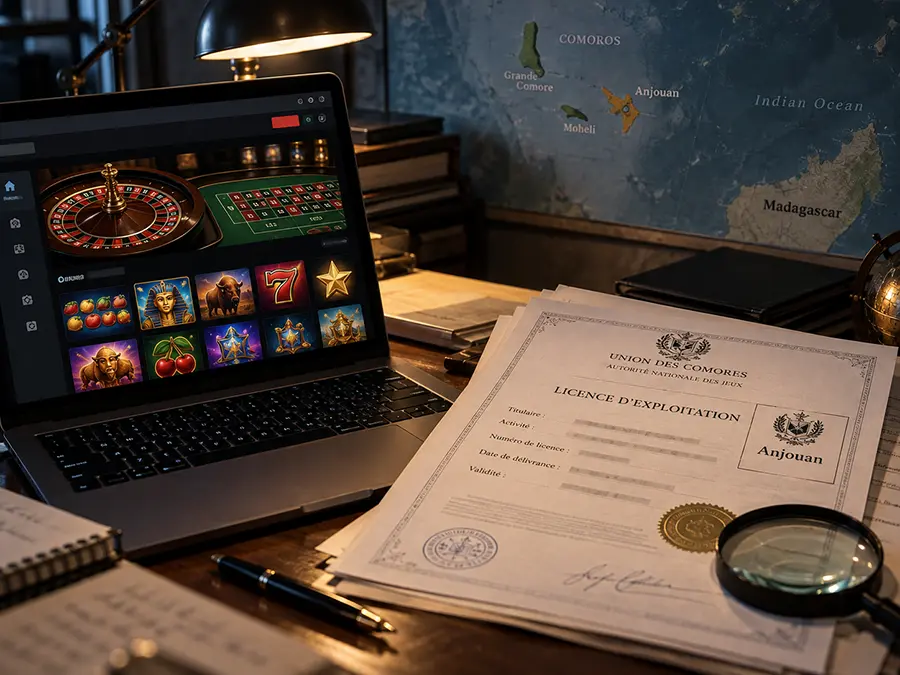
Close to 1,500 gambling operators hold a license from Anjouan, an island in the Comoros off the east coast of Africa. The government of the Comoros now says the people issuing those licenses have no authority to do so, is preparing legal action at home, and has asked Britain for help with individuals in the UK it links to the scheme.
That is from a Guardian investigation published October 19, and it matters because an Anjouan license is what a lot of newer crypto casinos point to when a player, a payment processor or a game supplier asks who regulates them. If the country whose name is on the certificate says the certificate is not real, that answer stops working.
What the Comoros is saying
The Comoros is a small country between Madagascar and Mozambique. Anjouan is one of its islands, and in the past few years its name has spread through the offshore casino business as a cheaper, quicker alternative to Curacao.
According to the Guardian, the Central Bank of the Comoros calls the Anjouan licensing network unauthorized and accuses the people behind it of trading on the country’s name to look legitimate. Officials say court action is being prepared inside the Comoros, that they are working with financial intelligence and law enforcement abroad, and that they have identified British citizens connected to the operation and asked UK authorities for assistance.
Those are allegations. No court has struck down the licenses, and nothing in the report shows that every operator holding one has done anything wrong. But it is the national government saying the regulator is not a regulator, and that is not a dispute an operator can wave away.
Why so many casinos went to Anjouan
For years Curacao was the default license for offshore casinos, largely because its master license and sublicense system was cheap and easy. Curacao has since reformed, moving to direct licensing with real checks on ownership, finances and responsible gambling. That made it slower and more expensive.
Anjouan filled the gap. The Guardian reports that Anjouan Corporate Services advertised licensing help for around £19,000, against roughly £80,000 for Curacao according to an industry source, though actual costs vary. For a small crypto casino that difference is the whole budget, and the question the Comoros is now raising is what, if anything, the £19,000 bought beyond a certificate and a listing on a website.
The London connection
The investigation ties the licensing arrangements to businesses in the UK. ACS Global Custodian, linked to Anjouan Corporate Services, connects through British company records to the Sorsky family, who are also involved in the London based Sherm Group.
Harold Sorsky told the Guardian that ACS Global Custodian has not sold or issued gaming licenses since a change of ownership in 2023, that references to its involvement are out of date, and that another provider took over that work. Past involvement is not the same as responsibility for licenses being issued today, and no legal finding has been made against anyone named in the report.
Who is on the register
The Anjouan Gaming Authority’s public register lists nearly 1,500 license holders, with companies incorporated in Panama, Belize and Costa Rica among them. The best known name is BC.Game, the crypto casino with the sports sponsorships. Most of the rest are small casinos few people have heard of.
Fifteen hundred license holders is not 1,500 casinos. One company can run many brands, and some entries are service businesses rather than operators. It is still a large slice of the offshore market resting on one disputed authority.
What the license is worth to a player
A license is supposed to tell you who is responsible for the casino, what rules it has to follow, and who you can complain to when it does not pay. Anjouan Gaming presents itself as doing all that. The government’s challenge is to the legal basis underneath it.
A license number on a footer and an entry on a register mean exactly as much as the body behind them, and no more. Two other things are worth knowing. An Anjouan license has never authorized a casino to take players from a country that licenses its own gambling, which Anjouan Gaming itself has acknowledged. And that is true of every offshore license, not just this one.
What the Guardian found at the tables
A reporter signed up at SlotsCharm, an Anjouan licensed casino, placed a few bets and stopped. The casino then contacted him more than 100 times by phone and email with promotions. A casino representative said it operates under its own rules.
The investigation also found Anjouan licensed sites marketed to British players looking to get around GamStop, the UK’s self exclusion scheme, which only covers UK licensed operators. Not every Anjouan casino behaves this way, and some offer their own exclusion tools. But when the regulator’s own standing is in question, there is nobody obvious to enforce the standards on the ones that do.
The practical test of any license is what happens when a casino refuses a withdrawal. A regulator that can make the casino pay is worth something. One that cannot is a logo.
Payments and software
Processors, game studios and affiliates all use licensing status when deciding who to work with. An operator that could show an Anjouan license to open a payment account may now be asked harder questions. Alun Bowden of Eilers & Krejcik Gaming told the Guardian that licensing is about reassurance for players and partners, and that reassurance is now harder to assess.
So far there is no sign that processors or major software suppliers have cut off Anjouan licensees as a group. Whether they do depends on where the Comoros case goes.
What happens next
The government has to make its challenge stick, either in its own courts or through cooperation abroad. Until it does, Anjouan licensed casinos are in limbo rather than shut down. Some will carry on and watch. Some will start the expensive process of licensing elsewhere, and the smallest will find that hardest.
The broader lesson is the same one Curacao taught. When a jurisdiction tightens up, operators move to wherever is cheapest, and the cheapest place is cheap for a reason. For anyone playing at an online casino that cites Anjouan, the question to ask now is what you would do if the casino stopped paying, because the answer may be that there is nobody to ask.
Last Updated: 5 days ago


