
An offshore casino can take your deposit in seconds. That does not prove much.
The real test comes later, when you try to withdraw, verify your account, read the bonus terms, or get support to answer a direct question. That is where safe offshore casinos separate themselves from risky ones.
For US players, the honest answer is this: offshore casinos are not automatically unsafe, but they are not protected the same way state licensed US casinos are. Some offshore operators are legitimate, pay players, and run professionally. Others use weak oversight, vague terms, slow withdrawals, or aggressive bonus rules to create problems after a player has already deposited.
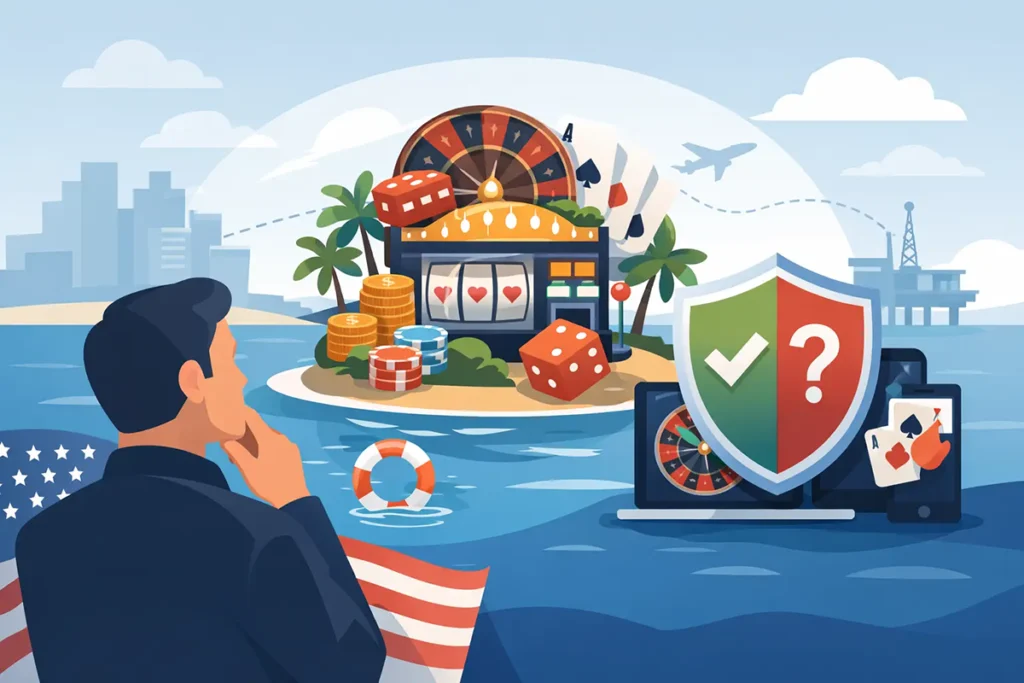
What Offshore Casino Safety Really Means
A safe offshore casino is not just a site with a big bonus, a clean homepage, and a long game list.
Those things are easy to advertise. They do not tell you enough.
Real safety comes down to how the casino behaves when money is involved. That means clear licensing, honest terms, predictable withdrawals, fair verification, reliable banking options, and support that does not disappear when there is a problem.
A casino can have secure payment pages and still be bad at paying players. It can offer real games and still use confusing bonus terms. It can look polished and still create unnecessary friction when you request a cashout.
That is why offshore casino safety has to be judged in parts, not as one blanket yes or no.
The Main Risk Is Accountability
The biggest difference between offshore casinos and state licensed US casinos is accountability.
A licensed US casino operates under a state regulator. If something goes wrong, players usually have a clearer complaint path. That does not mean every dispute is easy, but there is a formal system behind the operator.
With offshore casinos, that protection is weaker. The casino may be licensed overseas, but the regulator may be harder to contact, slower to respond, or limited in what it can actually enforce for a US player.
That does not make every offshore casino a scam. It means you need to be more selective.
You are trusting the operator, the license, the payment process, and the casino’s own history of handling withdrawals. If those pieces are weak, the risk goes up fast.
What Makes an Offshore Casino Safer?
The first thing to check is licensing.
A license is not a guarantee, but it is still a starting point. A safer offshore casino should clearly state who regulates it, where it is licensed, and which company operates the site. If those details are missing, vague, or inconsistent across the site, that is a bad sign.
The second thing to check is the terms.
A safer casino explains its rules clearly. You should be able to find information on bonus wagering, maximum bets, withdrawal limits, document checks, restricted locations, and payment timelines without digging through a maze of legal language.
The third thing to check is payout behavior.
This matters more than the bonus. A casino that routinely delays withdrawals, splits payments into small pieces, asks for the same documents again and again, or gives unclear reasons for holding funds should not be treated as low risk.
Slow does not always mean dishonest. But repeated slow pay patterns are a serious warning sign.
The Biggest Risks for US Players
US players should pay close attention to four problem areas.
The first is weak dispute resolution. If a withdrawal is delayed or winnings are voided, you may not have the same formal protection you would have with a state regulated US casino.
The second is verification friction. KYC checks are normal. The problem is when a casino accepts deposits easily but becomes much stricter only after a player wins. That imbalance is one of the biggest red flags in offshore gambling.
The third is bonus forfeiture. Large deposit matches and free chip offers can look attractive, but the terms often carry strict wagering rules, max bet limits, game restrictions, and withdrawal caps. A player can break a rule without realizing it and lose winnings during review.
The fourth is banking inconsistency. Crypto can make deposits and withdrawals faster, but it also adds risk. Transactions are harder to reverse, wallet mistakes can be costly, and some casinos apply extra review to crypto withdrawals. Traditional payment methods can also come with delays, rejected payouts, or processing limits.
Green Flags to Look For
A safer offshore casino usually does the simple things well.
It clearly identifies its license. It explains who operates the site. It lists realistic payout timeframes. It publishes specific bonus terms. It answers support questions directly. It does not hide the rules that matter most.
The best sign is consistency.
The casino says what the rules are before you deposit, then follows those rules when you withdraw.
That sounds basic, but in this space, basic transparency matters.
Red Flags to Avoid
Most bad signs appear before you deposit.
Watch out for terms that are hard to find, vague bonus language, unexplained withdrawal fees, unclear ownership, changing payment limits, and support agents who cannot explain verification or cashout rules.
Also be careful with casinos that promote bonuses heavily but say very little about withdrawals. Any operator can advertise free spins, crypto deposits, or instant play. Fewer are willing to clearly explain pending periods, maximum cashouts, document requirements, and payout limits.
That silence usually tells you where the friction will appear later.
How to Check an Offshore Casino Before Depositing
Start with the withdrawal page, not the bonus page.
Check the minimum withdrawal, maximum withdrawal, expected processing time, document requirements, fees, and whether the casino can split large payments into installments.
Then read the bonus terms only if you plan to claim a promotion. If the bonus has high wagering, a strict max bet rule, limited game contribution, or a low cashout cap, skipping the bonus may be the smarter move.
After that, test support.
Ask direct questions before depositing. Ask how long verification usually takes. Ask whether documents are required before the first withdrawal. Ask what happens if your deposit method cannot be used for cashouts.
Weak answers before you deposit usually become bigger problems after you win.
Finally, start small. A small first deposit lets you test the cashier, support, account process, and withdrawal system without putting too much money at risk.
Are Offshore Casinos Safe Enough to Use?
Some are. Many are not.
That is the answer most players need to hear.
Offshore casinos can be usable for US players when the operator has credible licensing, clear terms, fair verification, reliable banking, and a real history of paying players. But they should not be treated the same as tightly regulated US casino sites.
If you want stronger consumer protection, easier complaint options, and clearer legal oversight, offshore casinos may not fit your risk tolerance.
If you do use them, be selective. Avoid weak operators. Read the cashout rules first. Be careful with bonuses. Keep deposits controlled. Do not assume a casino is safe because it looks professional.
A cautious player does not ask whether an offshore casino looks legitimate.
They ask whether it explains the rules clearly, verifies accounts fairly, and pays withdrawals without turning every cashout into a negotiation.
Last Updated: 3 weeks ago