
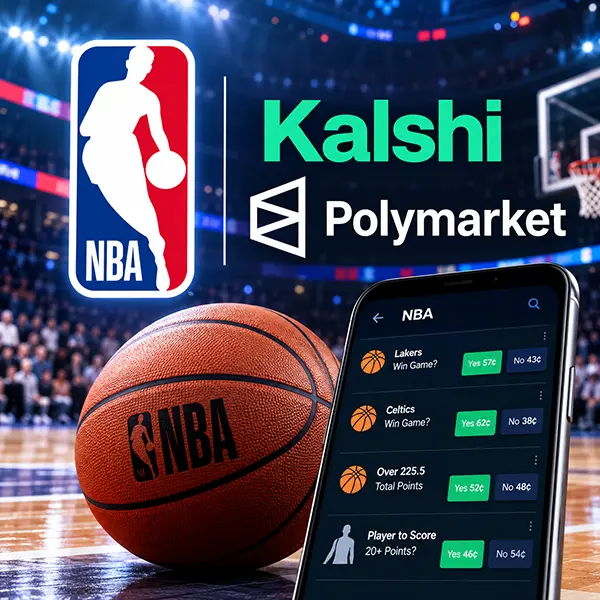
Two weeks after it banned certain player prop bets at licensed sportsbooks, the NBA has signed up the two biggest prediction markets as official partners. Kalshi and Polymarket are now the league’s preferred exchanges, under agreements announced October 26, 2026 that give the NBA a say over which basketball contracts they can list.
The league also signed an information sharing agreement with the CFTC, the federal regulator that oversees these markets. Taken together, the deals close a gap the prop ban had left open: the sportsbook restrictions did not reach prediction markets, and until now the NBA had no contract with them to enforce anything.
What the deals say
Beyond letting Kalshi and Polymarket call themselves NBA partners, the agreements commit both exchanges to:
- Let the league shape which NBA event contracts they offer.
- Bar NBA and team personnel from trading NBA contracts.
- Cooperate with integrity investigations and hand over trading data when asked.
- Take official league statistics through Sportradar, the NBA’s data partner.
- Use NBA branding and run approved promotions in the US.
Money was not disclosed. Scott Kaufman-Ross, the NBA’s head of media distribution and partnerships, framed it as an integrity measure first. The league has also widened its DraftKings deal to cover prediction markets and says more operator agreements are coming in the next few weeks.
Why now
On October 16 the NBA and its sportsbook partners pulled a set of player prop markets it considered too easy to manipulate: first basket bets, and combinations of statistical unders on players expected to see only a few minutes. The logic is that a player projected for two points and one rebound can hit the under by doing very little, and anyone who knows his minutes in advance has an edge nobody else can see.
Licensed sportsbooks took those markets down because the NBA’s agreements with them required it. Kalshi and Polymarket are regulated as derivatives exchanges, not sportsbooks, and the NBA had no commercial relationship to lean on. Monday’s deals fix that, and the league says the restrictions on its new partners will match the sportsbook rules. Whether every restricted contract has already come off both platforms is not something the announcement confirms.
The CFTC memorandum
The NBA’s agreement with the CFTC is a memorandum of understanding on sharing information about suspicious trading, insider activity and fraud in NBA contracts. CFTC Chairman Michael S. Selig called it another step in cooperation between the regulator and the leagues. MLB and the NHL already have similar arrangements.
It is a channel for talking, not a new rule. It does not give the NBA power over exchanges it has no deal with, and it does nothing to settle the fight between the CFTC and state gambling regulators over whether sports contracts are gambling at all.
Why that fight matters
A prediction market contract that pays $1 if the Celtics win, bought at 60 cents, is a bet on the Celtics at roughly -150 with different paperwork. Sportsbooks need a state license and have to follow state rules on advertising, consumer protection and responsible gambling. Kalshi and Polymarket operate under the Commodity Exchange Act and answer to the CFTC.
Several states say that distinction is meaningless for sports and are suing. The exchanges say federal law pre-empts the states. Courts have gone both ways, and the NFL has asked the Supreme Court to weigh in. The NBA is pointedly staying out of that argument. Its position is that whoever ends up regulating these markets, it wants a contract in place now that protects its games.
A different path from the NFL
The leagues have split. MLB and the NHL partnered with prediction markets early. The NFL has backed the states and pushed for clearer state authority over sports contracts. The NBA is doing what MLB did: sign the exchanges up and write integrity rules into the contract rather than wait for the courts.
That gets the league safeguards it could not otherwise impose. It also gives Kalshi and Polymarket official data, league branding and a marketing platform, which is worth a great deal to companies trying to look like legitimate sports betting operators. Integrity initiative and commercial deal are the same document here.
If you trade NBA contracts
Expect some markets to disappear or change as the exchanges bring their NBA listings into line, and expect more league branding on the ones that remain. Nothing about the partnership makes a prediction market a licensed sportsbook or makes its contracts legal in a state that says they are not. The contracts can still go to zero, and the fees and settlement rules are still the exchange’s, not the league’s.
What it signals
A year ago prediction markets were something the leagues worried about. Now three of the four major leagues have contracts with them, and the NBA is treating Kalshi and Polymarket much as it treats its sportsbook partners. The question left is whether the contractual safeguards hold up when the next suspicious trade appears, and what happens to all these agreements if the Supreme Court decides the states were right. For the technology running under both the exchanges and the sportsbooks, read how AI is changing sports betting and prediction markets.
Last Updated: 10 hours ago


