
World Cup winner odds are starting to get more attention as kickoff gets closer.
That is normal. Futures betting usually heats up before a major tournament because bettors want to lock in a price before the first match. Some are backing favorites. Some are looking for longshots. Others are betting with their heart and hoping their country makes a deep run.
That is where mistakes happen.
World Cup futures are easy to understand on the surface. You pick a team to win the tournament. If that team lifts the trophy, the bet wins. If not, it loses.
But the market is not as simple as picking the best team.
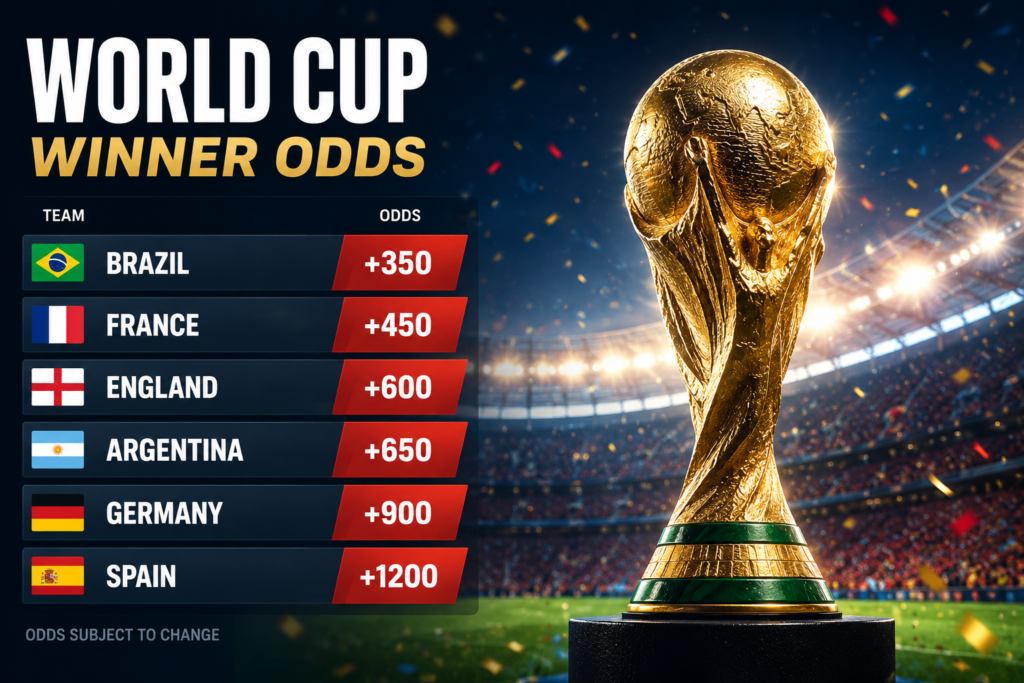
The price matters. The draw matters. The path matters. Injuries matter. Group stage matchups matter. Public betting attention matters. A team can be good and still be a bad futures bet if the number is too short.
That is the part American bettors need to understand before betting World Cup winner odds.
If you usually bet on the NFL, NBA, UFC, or March Madness, futures betting will feel familiar. But the World Cup has its own structure, and soccer betting has its own rules. Before betting the outright market, it helps to understand how futures connect to group betting, knockout round betting, 90 minute results, and to qualify markets.
World Cup Betting Guide for American Bettors
What Are World Cup Winner Odds?
World Cup winner odds are futures odds on which country will win the tournament.
This is also called the outright winner market.
If you bet France to win the World Cup, France must win the entire tournament. Reaching the final is not enough. Winning the group is not enough. Making the semifinals is not enough. The bet only wins if France lifts the trophy.
That makes it different from other World Cup markets.
You may also see markets like:
To win the group
To qualify from the group
To reach the quarterfinals
To reach the semifinals
To reach the final
To qualify for the next round
Top goalscorer
Team top goalscorer
Golden Ball winner
Golden Glove winner
Those are all futures style markets, but they are not the same as winner odds.
The outright winner market is the biggest version of the bet. It has the highest prize attached to the deepest tournament run.
The Favorites Are Not Always the Best Bets
The top of the World Cup odds board usually includes the same type of countries.
Elite squads. Proven tournament teams. Deep player pools. Strong managers. Big name attackers. Experience in knockout matches.
That is why countries like France, Spain, England, Brazil, Argentina, Portugal, Germany, and the Netherlands often get heavy attention.
But being one of the best teams does not automatically make a team the best bet.
This is the mistake casual bettors make.
They look at the odds board, see the favorites, and assume the safest team is the smartest pick. Sometimes that is true. Many times, it is not.
A favorite can be overpriced because the public wants to bet it. A popular team can carry shorter odds than it should. A defending champion can attract extra attention because of reputation. A star driven team can get bet heavily because of one famous player, even if the full squad has questions.
The question is not just, “Can this team win?”
The better question is:
Is this price worth the risk?
That is the entire point of futures betting.
Futures Betting Is About Path, Not Just Talent
The World Cup is not a league table.
The best team on paper does not automatically win. The tournament format creates pressure, randomness, matchup problems, and short windows where one mistake can end a campaign.
That is why path matters.
A team can look strong overall but face a difficult knockout route. Another team may not be quite as talented but could have a more favorable group and a cleaner path into the later rounds.
Bettors should look at more than the country name.
Important questions include:
Who is in the group?
Can this team win the group?
Who might it face in the knockout rounds?
Does the team have enough depth?
Is the squad healthy?
Does the team rely too heavily on one player?
Can it win different types of matches?
Can it handle extra time and penalties?
Is the betting price already too short?
That is how serious bettors look at World Cup futures.
They are not just ranking teams. They are ranking teams against their price.
Why Public Betting Can Move the Market
The World Cup brings in casual betting money.
That matters because casual bettors often back familiar teams, famous players, and countries they already support. American bettors may bet the United States because they want to root for the home team. Argentina may draw attention because of Lionel Messi. Portugal may attract bettors because of Cristiano Ronaldo. England always brings public interest. Brazil is always a recognizable World Cup brand.
Sportsbooks know this.
A popular team can be priced shorter than its true chances because the market expects public action. That does not mean the team cannot win. It means the value may not be as strong as the name suggests.
This is especially important before kickoff.
Once the tournament starts, odds can move quickly. A strong first match can shorten a team’s price. A bad performance can push it longer. An injury can change the market. A red card suspension can affect the next match. A surprise group result can change the knockout path.
Futures odds are not static. They are live opinions that change with information and betting demand.
How World Cup Futures Compare to March Madness
American bettors who understand March Madness already understand part of the futures concept.
You are not just betting the best team. You are betting the team’s path through the bracket.
The World Cup works in a similar way, but with soccer specific differences.
In March Madness, a strong team can lose one bad shooting night and go home. In the World Cup, a strong team can dominate possession, fail to score, go to penalties, and get eliminated. The margins are thin.
There is also the group stage before the knockout rounds. That means teams have to manage points, goal difference, squad rotation, and match order before the bracket fully forms.
That makes World Cup futures a mix of tournament projection and soccer market understanding.
You need to think like a bracket bettor, but you also need to understand soccer.
Group Winner Bets Can Be Smarter Than Outright Bets
Not every bettor needs to start with the World Cup winner market.
Sometimes a group winner bet or group qualification bet is cleaner.
A team may be unlikely to win the entire tournament but still be a strong option to win its group. Another team may have a tough group but still be well priced to qualify. These markets can give bettors a more focused angle instead of forcing them to predict the entire tournament.
That matters because outright futures require a lot to go right.
Your team has to survive the group stage, avoid major injuries, manage suspensions, win knockout matches, and handle high pressure moments. A group bet has a shorter timeline and fewer variables.
For beginners, group markets can be easier to understand than trying to pick the champion before the tournament starts.
To Qualify Is Different From To Win
One of the most important World Cup betting lessons is that “to qualify” and “to win” are not the same thing.
A team to qualify from the group only needs to advance. It does not need to win the group.
A team to qualify in a knockout match only needs to move on. It does not necessarily need to win in 90 minutes.
That matters because soccer has draws, extra time, and penalty shootouts.
If a knockout match is tied after 90 minutes, the match can go to extra time and penalties. A team can advance through penalties without winning the 90 minute result.
That is why American bettors need to read the exact market name.
A team to win in 90 minutes is one bet.
A team to qualify is another bet.
A team to win the tournament is another bet.
A team to win the group is another bet.
They are connected, but they are not interchangeable.
Do Not Bet Futures Like Fan Predictions
There is nothing wrong with having a favorite team. There is something wrong with pretending a fan pick is a sharp bet.
A lot of World Cup futures bets are emotional.
Fans bet their country. Casual bettors bet the biggest stars. People chase longshots because the payout looks exciting. Others bet favorites because they want something that feels safe.
That is not a strategy.
A better futures approach starts with price and probability.
Ask:
What has to happen for this bet to win?
Is the price fair?
Can this team survive the group?
Can it beat elite teams in knockout matches?
Does it have reliable goal scoring?
Can it defend under pressure?
Does it have penalty shootout quality?
Is the market already inflated?
If you cannot answer those questions, the bet may be more of a rooting ticket than a real value play.
That is fine if you know what you are doing. It is a problem if you think it is a strong bet just because the team is popular.
Longshots Need a Real Path
World Cup longshots are tempting.
A big payout always looks good before the tournament starts. The problem is that many longshots are longshots for a reason. They may have a tough group, limited attacking depth, defensive issues, injury concerns, or a brutal knockout path.
That does not mean every longshot is bad.
But a good longshot needs a real path.
It should have a realistic chance to get out of the group. It should have enough defensive structure to survive tight matches. It should have at least one reliable goal threat. It should have a possible knockout route that does not require beating three elite teams in a row.
If the only reason to bet the longshot is “the payout is huge,” that is not enough.
Big odds do not create value by themselves.
Star Players Can Distort Futures Markets
The World Cup is driven by stars.
That can create betting pressure around player led teams. Lionel Messi, Cristiano Ronaldo, Kylian Mbappe, Harry Kane, Lamine Yamal, Vinicius Junior, Jude Bellingham, and other major names can attract public attention quickly.
But futures betting is not the same as betting a single player award.
A country needs a full team to win the World Cup. It needs depth, defense, goalkeeping, midfield control, bench options, health, and tournament management.
A great player can swing a match. A great player cannot fix every weakness.
This is where casual bettors can overpay for name value.
Before betting a star led team, look at the full squad. Is the midfield strong enough? Is the defense reliable? Can the team create chances in different ways? What happens if the star is marked out of the match or not fully fit?
World Cup futures are team bets. Do not treat them like player props.
When to Bet World Cup Futures
There is no perfect time to bet a World Cup future.
Betting early can help if you think the price will shorten. Betting later can help if you want more information. Waiting until the group stage starts can reduce uncertainty, but the best numbers may already be gone.
Each approach has tradeoffs.
Betting before kickoff gives you access to the full board and longer prices. But you are taking on more injury risk, lineup uncertainty, and tournament unknowns.
Betting after the first match gives you more information. But if a team looks impressive, the odds may shorten quickly.
Betting during the tournament can create better reads on form, but the market will adjust fast.
For beginners, the safest approach is not always about timing. It is about bet size.
Do not overcommit before you have enough information. Futures tie up your stake for the full tournament and lose if the team falls short.
Best Futures Markets for American Bettors
If you are new to World Cup futures, the outright winner market is not your only option.
These markets may be easier to understand:
| Market | What It Means | Why It Can Help |
|---|---|---|
| To win the World Cup | Team must win the tournament | Highest profile futures market |
| To reach the final | Team must make the final | Less demanding than winning it all |
| To reach the semifinal | Team must make the final four | Useful for strong teams with realistic paths |
| To win the group | Team must finish first in its group | Focuses on the group stage |
| To qualify from group | Team must advance from its group | Easier than picking group winner |
| Top goalscorer | Player must score the most goals | Depends on team path and playing time |
| Team top scorer | Player must lead his team in goals | More focused than full tournament top scorer |
The best market depends on your opinion.
If you think a team is strong but not likely to win the whole thing, reaching the semifinal may make more sense than betting the outright. If you think a team has an easy group, group winner may be cleaner. If you like a player but not his team’s title chances, team top scorer may be better than Golden Boot.
What American Bettors Should Remember
World Cup winner odds are exciting, but they are not simple lottery tickets.
The outright market asks a lot from one bet. Your team has to survive the group stage, manage injuries, handle pressure, win knockout matches, and avoid one bad mistake at the wrong time.
That is why betting the favorite is not automatically smart. Betting a longshot is not automatically clever. Betting your favorite country is not automatically value.
The smarter move is to understand the market before placing the bet.
Know the difference between winner odds, group winner odds, to qualify markets, and 90 minute match betting. Understand that soccer has draws. Understand that a team can advance without winning in regulation. Understand that penalty shootouts can decide a tournament without changing every bet type.
The World Cup is going to bring in a lot of American bettors who are more familiar with the NFL, NBA, UFC, and March Madness. That is fine. The betting concepts are learnable.
But futures bets require patience.
Before betting World Cup winner odds, ask the only question that really matters:
Is this team’s chance of winning better than the price being offered?
If the answer is yes, the bet may be worth considering. If the answer is only “I like the team,” that is a rooting interest, not a betting edge.
- Betting Guide
- Betting Bonuses & Free Bets
- Outright Winner Odds
- World Cup Matchups
- How to Bet on World Cup
- World Cup Predictions
Last Updated: 4 months ago