
Arizona gambling regulators ordered the company behind Chumba Casino, Global Poker and Luckyland Slots to stop operating in the state nearly two years ago. Yet the sweepstakes gaming platforms have continued accepting Arizona customers, raising questions about how effectively state authorities can enforce gambling laws against operators based overseas.
An investigation published October 22, 2026, by The Arizona Republic revealed that the Arizona Department of Gaming issued a cease-and-desist letter to Virtual Gaming Worlds (VGW) in November 2024. Regulators alleged that the company’s sweepstakes gaming model violated Arizona gambling laws and warned that civil or criminal charges could follow.
No such charges had been announced as of October 27, 2026. The department maintains that VGW’s operations are unlawful, while the company disputes that interpretation and says it complies with applicable regulations.
The investigation also uncovered substantial political contributions from VGW to organizations supporting both Democratic and Republican officials in Arizona. There is no established evidence that those donations influenced enforcement decisions.
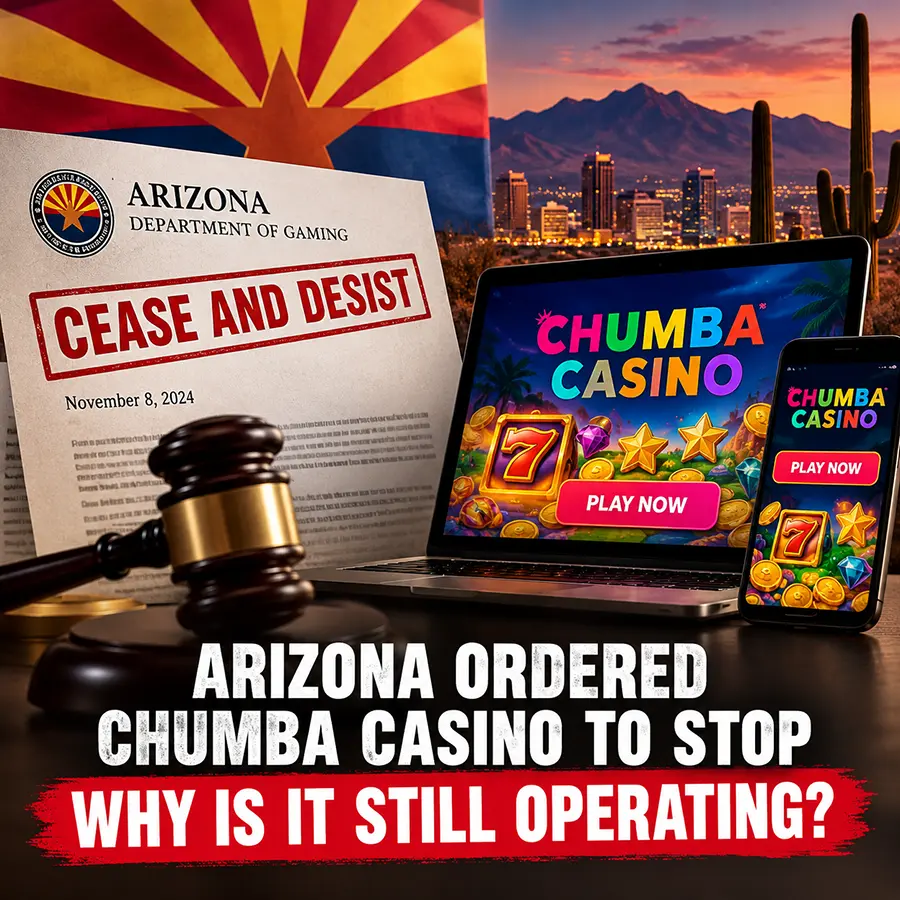
Arizona Regulators Ordered VGW to Stop Operating in November 2024
The dispute began on November 8, 2024, when the Arizona Department of Gaming sent VGW a cease-and-desist letter targeting its online gaming platforms.
According to documents obtained by The Arizona Republic, regulators concluded that Chumba Casino, Global Poker and Luckyland Slots were offering unauthorized gambling to Arizona residents.
The department argued that the company’s business model violated state laws because customers could purchase virtual currency, participate in casino-style games and potentially redeem prizes for cash.
Arizona officials characterized the alleged violations as serious enough to constitute a felony gambling enterprise.
VGW challenged the department’s interpretation in December 2024, maintaining that its sweepstakes model did not constitute illegal gambling because customers could participate without making purchases.
The department rejected that argument in a December 10 response, reaffirming its conclusion that VGW was promoting unlicensed gambling.
Despite the disagreement, the enforcement effort did not result in publicly announced civil or criminal proceedings.
The existence of the earlier correspondence became public through the newspaper’s investigation, which found that Arizona had not publicized its allegations against VGW as it had done with some other sweepstakes operators.
Chumba Casino Remained Accessible to Arizona Players
One of the investigation’s most significant findings was that Chumba Casino remained accessible from Arizona in October 2026.
A reporter for The Arizona Republic attempted to register using a Phoenix address and was asked to provide location information, identification and proof of residency.
The reporter was also able to participate in casino-style games while physically located in Phoenix.
That finding matters because VGW’s own account verification process appeared capable of identifying a customer’s state of residence.
The company therefore was not simply dealing with customers whose locations were unknown.
As of October 21, Arizona was also absent from the list of excluded states in the company’s published terms and conditions, according to the investigation.
The Arizona Department of Gaming confirmed that it continued to consider VGW’s activities illegal.
Department spokesperson Jessica Roza said regulators were still evaluating possible enforcement options.
The Attorney General’s Office also acknowledged that pursuing an overseas operator presents jurisdictional and resource challenges.
Those difficulties help explain why issuing a cease-and-desist demand does not necessarily lead to an immediate shutdown.
How Sweepstakes Casinos Differ From Licensed Online Casinos
The dispute centers on a business model that has become increasingly controversial across the United States.
Traditional real money online casinos allow customers to deposit money and wager directly on casino games. These operators generally require state gambling licences in jurisdictions where regulated online casino gaming is permitted.
Sweepstakes casinos use a different structure.
Platforms such as Chumba Casino typically offer virtual currencies, including Gold Coins for entertainment play and Sweeps Coins that can be used in promotional sweepstakes games.
Eligible Sweeps Coins winnings may be redeemable for cash prizes or other rewards, subject to the operator’s terms.
Customers can generally obtain sweepstakes entries through free methods, although some platforms also award promotional currency alongside purchases of virtual coins.
Operators argue that the availability of free participation distinguishes their products from conventional gambling.
Regulators in several states disagree, arguing that the combination of purchases, casino-style gameplay and redeemable prizes can amount to gambling regardless of whether a free-entry option exists.
Arizona’s dispute with VGW illustrates that disagreement.
The state considers the company’s activities unauthorized gambling. VGW maintains that its sweepstakes model is lawful.
Importantly, the regulator’s cease-and-desist letter is not the same as a final court judgment establishing that VGW committed a crime.
Political Donations Raise Questions About Enforcement
The investigation also examined VGW’s political spending during the period when its Arizona operations were under regulatory scrutiny.
According to campaign finance records reviewed by The Arizona Republic, VGW and related entities contributed more than $200,000 to organizations supporting Democratic Governor Katie Hobbs and Attorney General Kris Mayes.
The company also contributed approximately $150,000 to Republican political organizations, including groups supporting legislative candidates and the campaign of Warren Petersen, who is challenging Mayes.
The donations were made while the company faced increasing regulatory pressure in Arizona and other states.
The timing raises questions about how gambling companies seek political influence while operating in legally disputed markets.
However, political contributions are not evidence that public officials accepted improper payments or interfered with enforcement proceedings.
The investigation did not establish that the donations caused Arizona regulators to delay or abandon action against VGW.
Representatives of the governor’s office defended the administration’s record on illegal gambling enforcement.
The Attorney General’s Office cited limited enforcement resources and the complications involved in pursuing a company headquartered outside the United States.
VGW has also maintained that it supports engagement with state governments on appropriate regulatory frameworks for sweepstakes gaming.
What the Dispute Means for Sweepstakes Casino Players
For Arizona customers, the central issue is not simply whether Chumba Casino remains accessible.
It is whether players using sweepstakes platforms receive the same protections available through state-regulated gambling operators.
Arizona regulators have expressed concerns about unlicensed gaming websites, including the ability to investigate customer complaints and enforce consumer protection requirements.
Understanding how to verify a casino’s licensing and regulatory oversight is an important part of evaluating an online gambling site.
The Department of Gaming told The Arizona Republic that consumers had reported problems involving sweepstakes operators, including difficulties receiving payouts and concerns about self-exclusion.
Those complaints were described as industry-wide concerns and should not be interpreted as verified findings that VGW denied legitimate withdrawals or violated specific self-exclusion requests.
Players should also review a casino’s withdrawal policies before depositing, including verification requirements, payout limits and processing times.
Nevertheless, they highlight practical questions customers should consider before using any sweepstakes casino.
Players should understand how prize redemptions work, what identification documents are required, whether redemption limits apply and which authority can help resolve a dispute.
They should also check whether the operator permits customers from their state.
A website being accessible does not necessarily mean state regulators consider its activities lawful.
Arizona’s Enforcement Challenges Reflect a Wider National Debate
Arizona is not alone in questioning the legality of sweepstakes casinos.
Regulators and lawmakers across the United States have increasingly challenged dual-currency gaming platforms, arguing that their products resemble real-money casino gambling without the licensing and oversight required of traditional operators.
Some states have adopted legislation targeting sweepstakes casinos, while others have pursued cease-and-desist letters, lawsuits or other enforcement measures.
Operators have responded in different ways. Some have withdrawn from particular states, while others have challenged regulators’ interpretations of existing gambling laws.
The VGW case is notable because Arizona took action privately in 2024, yet the company continued operating in the state nearly two years later.
It demonstrates a central difficulty facing regulators: identifying an allegedly illegal operator and directing it to stop does not automatically provide the resources or legal authority needed to force compliance, particularly when the company operates internationally.
What Happens Next for VGW in Arizona?
As of October 27, Arizona had not announced a civil lawsuit, criminal prosecution or negotiated settlement arising from its November 2024 cease-and-desist demand against VGW.
The Department of Gaming continued to maintain that the company’s activities violated state law and said enforcement options remained under consideration.
VGW continued to dispute the state’s legal interpretation and expressed confidence in its compliance with applicable laws.
For now, the disagreement remains unresolved.
The larger question is whether Arizona will pursue additional enforcement measures or whether the dispute will continue without a definitive legal ruling.
For consumers, the case is a reminder that sweepstakes casino availability, regulatory approval and legal status are not necessarily the same thing.
For the industry, it illustrates how the rapid expansion of sweepstakes gaming has exposed differences between existing gambling laws, regulatory resources and the ability of states to enforce their rules against overseas operators.
Last Updated: 16 minutes ago


